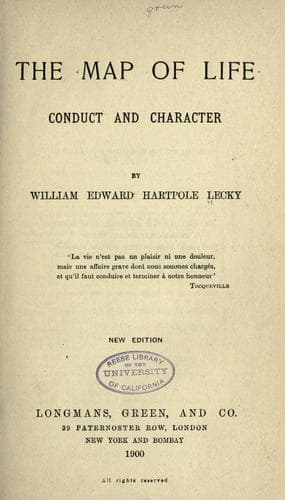
The Map of Life: Conduct and CharacterLecky, William Edward Hartpole
Philosophy
The Map of Life: Conduct and Character
Lecky, William Edward Hartpole
Character; Conduct of life
Experience abundantly shows how powerfully the steady action of such a
will can operate upon innate defects, converting the constitutional
idler into the indefatigably industrious, checking, limiting and
sometimes almost destroying constitutional irritability and vicious
passions. The natural power of the will in different men differs
greatly, but there is no part of our nature which is more strengthened
by exercise or more weakened by disuse. The minor faults of character it
can usually correct; but when a character is once formed, and when its
tendencies are essentially vicious, radical cure or even considerable
amelioration is very rare. Sometimes the strong influence of religion
effects it. Sometimes it is effected by an illness, a great misfortune,
or the total change of associations that follows emigration. Marriage
perhaps more frequently than any other ordinary agency in early life
transforms or deeply modifies the character, for it puts an end to
powerful temptations and brings with it a profound change of habits and
motives, associations and desires. But we have all of us encountered in
life depraved natures in which vicious self-indulgence had attained such
a strength, and the recuperating and moralising elements were so fatally
weak, that we clearly perceive the disease to be incurable, and that it
is hardly possible that any change of circumstances could even seriously
mitigate it. In what proportion this is the fault or the calamity of the
patient no human judgment can accurately tell.
Few things are sadder than to observe how frequently the inheritance of
great wealth or even of easy competence proves the utter and speedy ruin
of a young man, except when the administration of a large property, or
the necessity of carrying on a great business, or some other propitious
circumstance provides him with a clearly defined sphere of work. The
majority of men will gladly discard distasteful work which their
circumstances do not require; and in the absence of steady work, and in
the possession of all the means of gratification, temptations assume an
overwhelming strength, and the springs of moral life are fatally
impaired. It can hardly be doubted that the average longevity in this
small class is far less than in that of common men, and that even when
natural capacity is considerable it is more rarely displayed. To a man
with a real desire for work such circumstances are indeed of inestimable
value, giving him the leisure and the opportunities of applying himself
without distraction and from early manhood to the kind of work that is
most suited to him. Sometimes this takes place, but much more frequently
vicious tastes or a simply idle or purposeless life are the result.
Sometimes, indeed, a large amount of desultory and unregulated energy
remains, but the serious labour of concentration is shunned and no real
result is attained. The stream is there, but it turns no mill.
Public-domain text, read in full here on John Shaqi.
Reviews
Reviews
No reviews yet
Be the first to share your thoughts on this work.
Elsewhere in the archive
Join the Discussion
Join the discussion
Sign in to leave a comment or review.
Sign InorCreate an account