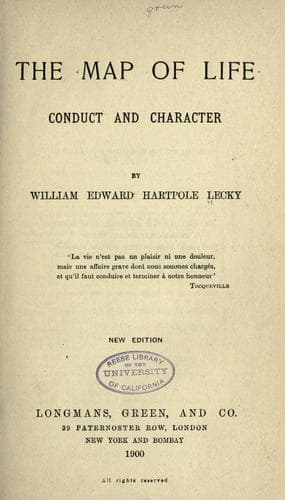
The Map of Life: Conduct and CharacterLecky, William Edward Hartpole
Philosophy
The Map of Life: Conduct and Character
Lecky, William Edward Hartpole
Character; Conduct of life
Very much, however, of the management of character can only be
accomplished by the individual himself acting in complete isolation upon
his own nature and in the chamber of his own mind. The discipline of
thought; the establishment of an ascendency of the will over our courses
of thinking; the power of casting away morbid trains of reflection and
turning resolutely to other subjects or aspects of life; the power of
concentrating the mind vigorously on a serious subject and pursuing
continuous trains of thought,--form perhaps the best fruits of judicious
self-education. Its importance, indeed, is manifold. In the higher walks
of intellect this power of mental concentration is of supreme value.
Newton is said to have ascribed mainly to an unusual amount of it his
achievements in philosophy, and it is probable that the same might be
said by most other great thinkers. In the pursuit of happiness hardly
anything in external circumstances is so really valuable as the power of
casting off worry, turning in times of sorrow to healthy work, taking
habitually the brighter view of things. It is in such exercises of will
that we chiefly realise the truth of the lines of Tennyson:
Oh, well for him whose will is strong,
He suffers, but he will not suffer long.
In moral culture it is not less important to acquire the power of
discarding the demoralising thoughts and imaginations that haunt so
many, and meeting temptation by calling up purer, higher and restraining
thoughts. The faculty we possess of alternating and intensifying our own
motives by bringing certain thoughts, or images, or subjects into the
foreground and throwing others into the background, is one of our chief
means of moral progress. The cultivation of this power is a far wiser
thing than the cultivation of that introspective habit of mind which is
perpetually occupied with self-analysis or self-examination, and which
is constantly and remorsefully dwelling upon past faults or upon the
morbid elements in our nature. In the morals which are called minor,
though they affect deeply the happiness of mankind, the importance of
the government of thought is not less apparent. The secret of good or
bad temper is our habitual tendency to dwell upon or to fly from the
irritating and the inevitable. Content or discontent, amiability or the
reverse, depend mainly upon the disposition of our minds to turn
specially to the good or to the evil sides of our own lot, to the merits
or to the defects of those about us. A power of turning our thoughts
from a given subject, though not the sole element in self-control, is at
least one of its most important ingredients.
Public-domain text, read in full here on John Shaqi.
Reviews
Reviews
No reviews yet
Be the first to share your thoughts on this work.
Elsewhere in the archive
Join the Discussion
Join the discussion
Sign in to leave a comment or review.
Sign InorCreate an account