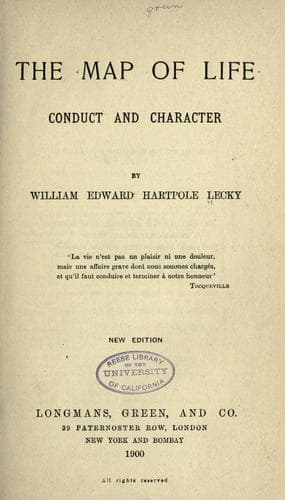
The Map of Life: Conduct and CharacterLecky, William Edward Hartpole
Philosophy
The Map of Life: Conduct and Character
Lecky, William Edward Hartpole
Character; Conduct of life
Most men escape this danger through the circumstances of life which make
serious and steady work necessary to their livelihood, and in the
majority of cases the kind of work is so clearly marked out that they
have little choice. When some choice exists, the rule which I have
already laid down should not be forgotten. Men should choose their work
not only according to their talents and their opportunities, but also,
as far as possible, according to their characters. They should select
the kinds which are most fitted to bring their best qualities into
exercise, or should at least avoid those which have a special tendency
to develop or encourage their dominant defects. On the whole it will be
found that men's characters are much more deeply influenced by their
pursuits than by their opinions.
The choice of work is one of the great agencies for the management of
character in youth. The choice of friends is another. In the words of
Burke, 'The law of opinion ... is the strongest principle in the
composition of the frame of the human mind, and more of the happiness
and unhappiness of man reside in that inward principle than in all
external circumstances put together.'[63] This is true of the great
public opinion of an age or country which envelops us like an
atmosphere, and by its silent pressure steadily and almost insensibly
shapes or influences the whole texture of our lives. It is still more
true of the smaller circle of our intimacies which will do more than
almost any other thing to make the path of virtue easy or difficult. How
large a proportion of the incentives to a noble ambition, or of the
first temptations to evil, may be traced to an early friendship, and it
is often in the little circle that gathers round a college table that
the measure of life is first taken, and ideals and enthusiasms are
formed which give a colour to all succeeding years. To admire strongly
and to admire wisely is, indeed, one of the best means of moral
improvement.
Public-domain text, read in full here on John Shaqi.
Reviews
Reviews
No reviews yet
Be the first to share your thoughts on this work.
Elsewhere in the archive
Join the Discussion
Join the discussion
Sign in to leave a comment or review.
Sign InorCreate an account