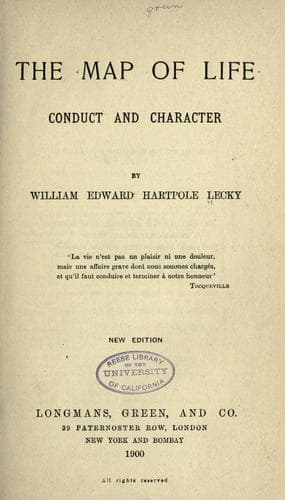
The Map of Life: Conduct and CharacterLecky, William Edward Hartpole
Philosophy
The Map of Life: Conduct and Character
Lecky, William Edward Hartpole
Character; Conduct of life
In this as in most questions affecting life there are opposite dangers
to be avoided, and wisdom lies mainly in a just sense of proportion and
degree. That sanitary reform, promoted by governments, has on the whole
been a great blessing seems to me scarcely open to reasonable question,
but many of the best judges are of opinion that it may easily be pushed
to dangerous extremes. Few things are more curious than to observe how
rapidly during the past generation the love of individual liberty has
declined; how contentedly the English race are submitting great
departments of their lives to a web of regulations restricting and
encircling them. Each individual case must be considered on its merits,
and few persons will now deny that the right of adult men and women to
regulate the conditions of their own work and to determine the risks
that they will assume may be wisely infringed in more cases than the
Manchester School would have admitted. At the same time the marked
tendency of this generation to extend the stringency and area of
coercive legislation in the fields of industry and sanitary reform is
one that should be carefully watched. Its exaggerations may in more ways
than one greatly injure the very classes it is intended to benefit.
A somewhat corresponding statement may be made about individual sanitary
education. It is, as I have said, a matter of the most vital importance
that we should acquire in youth the knowledge and the habits that lead
to a healthy life. The main articles of the sanitary creed are few and
simple. Moderation and self-restraint in all things--an abundance of
exercise, of fresh air, and of cold water--a sufficiency of steady work
not carried to excess--occasional change of habits and abstinence from a
few things which are manifestly injurious to health, are the cardinal
rules to be observed. In the great lottery of life, men who have
observed them all may be doomed to illness, weak vitality, and early
death, but they at least add enormously to the chances of a strong and
full life. The parent will need further knowledge for the care of his
children, but for self-guidance little more is required, and with early
habits an observance of the rules of health becomes almost instinctive
and unconscious. But while no kind of education is more transcendently
important than this, it is not unfrequently carried to an extreme which
defeats its own purpose. The habit that so often grows upon men with
slight chronic maladies, or feeble temperament, or idle lives, of making
their own health and their own ailments the constant subject of their
thoughts soon becomes a disease very fatal to happiness and positively
injurious to health. It is well known how in an epidemic the
panic-stricken are most liable to the contagion, and the life of the
habitual valetudinarian tends promptly to depress the nerve energy which
provides the true stamina of health. In the words of an eminent
Public-domain text, read in full here on John Shaqi.
Reviews
Reviews
No reviews yet
Be the first to share your thoughts on this work.
Join the Discussion
Join the discussion
Sign in to leave a comment or review.
Sign InorCreate an account