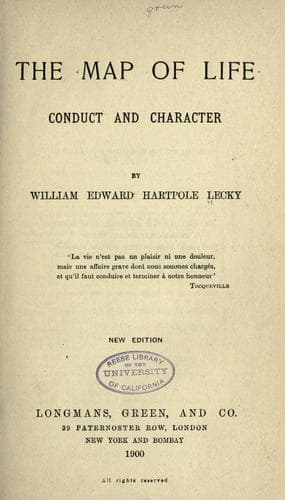
The Map of Life: Conduct and CharacterLecky, William Edward Hartpole
Philosophy
The Map of Life: Conduct and Character
Lecky, William Edward Hartpole
Character; Conduct of life
A more common type in England is that of the active politician. Great
wealth and especially great landed property bring men easily into
Parliament, and, if united with industry and some measure of ability,
into official life, and public life thus becomes a profession and in
many cases a very laborious one. There are few better examples of a
well-filled life and of the skilful management and economy of time than
are to be found in the lives of some great noblemen who take a leading
part in politics and preside over important Government departments
without suffering their gigantic estates to fall into mismanagement, or
neglecting the many social duties and local interests connected with
them. Most of their success is indeed due to the wise use of money in
economising time by trustworthy and efficient delegation. Yet the
superintending brain, the skilful choice, the personal control cannot
be dispensed with. In a life so fully occupied the few weeks of pleasure
which may be spent on a Scotch moor or in a Continental watering-place
will surely not be condemned.
The economy of time and the elasticity of brain and character such lives
develop are, however, probably exceeded by another class. Nothing is
more remarkable in the social life of the present generation than the
high pressure under which a large number of ladies in great positions
habitually live. It strikes every Continental observer, for there is
nothing approaching it in any other European country, and it certainly
far exceeds anything that existed in England in former generations.
Pleasure-seeking, combined, however, on a large scale with
pleasure-giving, holds a much more prominent place in these lives than
in those I have just described. With not a few women, indeed, of wealth
and position, it is the all-in-all of life, and in general it is
probable that women obtain more pleasure from most forms of society than
men, though it is also true that they bear a much larger share of its
burdens. There are, however, in this class, many who combine with
society a truly surprising number and variety of serious interests. Not
only the management of a great house, not only the superintendence of
schools and charities and local enterprises connected with a great
estate, but also a crowd of philanthropic, artistic, political, and
sometimes literary interests fill their lives. Few lives, indeed, in any
station are more full, more intense, more constantly and variously
occupied. Public life, which in most foreign countries is wholly outside
the sphere of women, is eagerly followed. Public speaking, which in the
memory of many now living was almost unknown among women of any station
in English society, has become the most ordinary accomplishment. Their
object is to put into life from youth to old age as much as life can
give, and they go far to attain their end. A wonderful nimbleness and
flexibility of intellect capable of turning swiftly from subject to
Public-domain text, read in full here on John Shaqi.
Reviews
Reviews
No reviews yet
Be the first to share your thoughts on this work.
Elsewhere in the archive
Join the Discussion
Join the discussion
Sign in to leave a comment or review.
Sign InorCreate an account