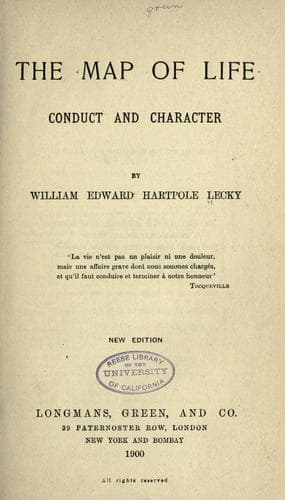
The Map of Life: Conduct and CharacterLecky, William Edward Hartpole
Philosophy
The Map of Life: Conduct and Character
Lecky, William Edward Hartpole
Character; Conduct of life
subject has been developed, and keeps them in touch with a very wide
range both of interests and pleasures.
There are no doubt grave drawbacks to all this. Many will say that this
external activity must be at the sacrifice of the duties of domestic
life, but on this subject there is, I think, at least much exaggeration.
Education has now assumed such forms and attained such a standard that
usually for many hours in the day the education of the young in a
wealthy family is in the hands of accomplished specialists, and I do not
think that the most occupied lives are those in which the cares of a
home are most neglected. How far, however, this intense and constant
strain is compatible with physical well-being is a graver question, and
many have feared that it must bequeath weakened constitutions to the
coming generation. Nor is a life of incessant excitement in other
respects beneficial. In both intellectual and moral hygiene the best
life is that which follows nature and alternates periods of great
activity with periods of rest. Retirement, quiet, steady reading, and
the silent thought which matures character and deepens impressions are
things that seem almost disappearing from many English lives. But lives
such as I have described are certainly not useless, undeveloped, or
wholly selfish, and they in a large degree fulfil that great law of
happiness, that it should be sought for rather in interests than in
pleasures.
I have already referred to the class who value money chiefly because it
enables them to dismiss money thoughts and cares from their minds. On
the whole, this end is probably more frequently attained by men of
moderate but competent fortunes than by the very rich. This is at least
the case when they are sufficiently rich to invest their money in
securities which are liable to no serious risk or fluctuation. A
gigantic fortune is seldom of such a nature that it does not bring with
it great cares of administration and require much thought and many
decisions. There is, however, one important exception. When there are
many children the task of providing for their future falls much more
lightly on the very rich than on those of medium fortune.
Public-domain text, read in full here on John Shaqi.
Reviews
Reviews
No reviews yet
Be the first to share your thoughts on this work.
Elsewhere in the archive
Join the Discussion
Join the discussion
Sign in to leave a comment or review.
Sign InorCreate an account