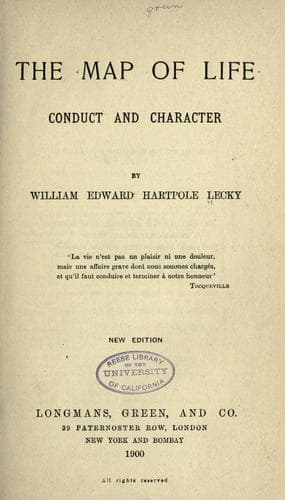
The Map of Life: Conduct and CharacterLecky, William Edward Hartpole
Philosophy
The Map of Life: Conduct and Character
Lecky, William Edward Hartpole
Character; Conduct of life
It is probable that the highest form of charity, involving real and
serious self-denial, is much more common among the poor, and even the
very poor, than among the rich. I think most persons who have had much
practical acquaintance with the dealings of the poor with one another
will confirm this. It is certainly far less common among those who are
at the opposite pole of fortune. They have not had the same discipline,
or indeed the same possibility of self-sacrifice, or the same means of
realising the pains of poverty, and there is another reason which tends
not unnaturally to check their benevolence. A man with the reputation of
great wealth soon finds himself beleaguered by countless forms of
mendicancy and imposture. He comes to feel that there is a general
conspiracy to plunder him, and he is naturally thrown into an attitude
of suspicion and self-defence. Often, though he may give largely and
generously, he will do so under the veil of strict anonymity, in order
to avoid a reputation for generosity which will bring down upon him
perpetual solicitations. If he is an intellectual man he will probably
generalise from his own experience. He will be deeply impressed with the
enormous evils that have sprung from ill-judged charity, and with the
superiority even from a philanthropic point of view of a productive
expenditure of money.
And in truth it is difficult to overrate the evil effects of injudicious
charities in discouraging thrift, industry, foresight and self-respect.
They take many forms; some of them extremely obvious, while others can
only be rightly judged by a careful consideration of remote
consequences. There are the idle tourists who break down, in a once
unsophisticated district, that sense of self-respect which is one of the
most valuable lessons that early education can give, by flinging pence
to be scrambled for among the children, or who teach the poor the fatal
lesson that mendicancy or something hardly distinguishable from
mendicancy will bring greater gain than honest and continuous work.
There is the impulsive, uninquiring charity that makes the trade of the
skilful begging-letter writer a lucrative profession, and makes men and
women who are rich, benevolent and weak, the habitual prey of greedy
impostors. There is the old-established charity for ministering to
simple poverty which draws to its centre all the pauperism of the
neighbouring districts, depresses wages, and impoverishes the very
district or class it was intended to benefit. There are charities which
not only largely diminish the sufferings that are the natural
consequence and punishment of vice; but even make the lot of the
criminal and the vicious a better one than that of the hard-working
poor. There are overlapping charities dealing with the same department,
but kept up with lavish waste through the rivalry of different religious
denominations, or in the interests of the officials connected with them;
Public-domain text, read in full here on John Shaqi.
Reviews
Reviews
No reviews yet
Be the first to share your thoughts on this work.
Elsewhere in the archive
Join the Discussion
Join the discussion
Sign in to leave a comment or review.
Sign InorCreate an account