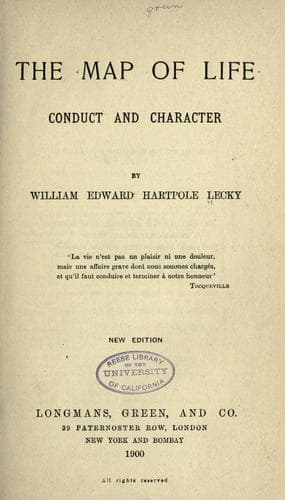
The Map of Life: Conduct and CharacterLecky, William Edward Hartpole
Philosophy
The Map of Life: Conduct and Character
Lecky, William Edward Hartpole
Character; Conduct of life
eyes of economists of this school is the path of wisdom, and they were
profoundly distrustful of all legislative attempts to restrict or
interfere with the course of industrial progress.
In our own generation a somewhat different tendency has manifestly
strengthened. It has been said that past political economists paid too
much attention to the accumulation and too little to the distribution of
wealth. Men have become more sensible to the high level of happiness and
moral well-being that has been attained in some of the smaller and
somewhat stagnant countries of Europe, where wealth is more generally
attained by thrift and steady industry than by great industrial or
commercial enterprise, in which there are few large fortunes but little
acute poverty, a low standard of luxury, but a high standard of real
comfort. The enormous evils that have grown up in wealthy countries, in
the form of company-mongering, excessive competition, extravagant and
often vicious luxury, and dishonest administration of public funds, are
more and more felt, and it is only too true that in these countries
there are large and influential circles of society in which all
considerations of character, intellect, or manners seem lost in an
intense thirst for wealth and for the things that it can give.
Sometimes we find vast fortunes in countries where there is but little
enterprise and a very low standard of comfort among the people, and
where this is the case it is usually due to unequal laws or corrupt
administration. In the free, democratic, and industrial communities
great fluctuations and disparities of wealth are inevitable, and some of
the most colossal fortunes have, no doubt, been made by the evil methods
I have described. They are, however, only a minority, and not a very
large one. Like all the great successes of life, abnormal accumulation
of wealth is usually due to the combination in different proportions of
ability, character, and chance, and is not tainted with dishonesty. On
the whole, the question that should be asked is not what a man has, but
how he obtained it and how he uses it. When wealth is honestly acquired
and wisely and generously used, the more rich men there are in a country
the better.
Public-domain text, read in full here on John Shaqi.
Reviews
Reviews
No reviews yet
Be the first to share your thoughts on this work.
Elsewhere in the archive
Join the Discussion
Join the discussion
Sign in to leave a comment or review.
Sign InorCreate an account