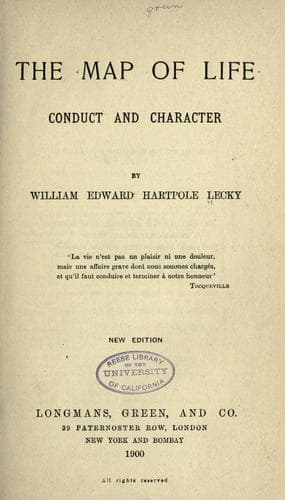
The Map of Life: Conduct and CharacterLecky, William Edward Hartpole
Philosophy
The Map of Life: Conduct and Character
Lecky, William Edward Hartpole
Character; Conduct of life
There has probably never been a period in the history of the world when
the conditions of industry, assisted by the great gold discoveries in
several parts of the globe, were so favourable to the formation of
enormous fortunes as at present, and when the race of millionaires was
so large. The majority belong to the English-speaking race; probably
most of their gigantic fortunes have been rapidly accumulated, and bring
with them none of the necessary, hereditary, and clearly defined
obligations of a great landowner, while a considerable proportion of
them have fallen to the lot of men who, through their education or early
habits, have not many cultivated or naturally expensive tastes. In
England many of the new millionaires become great landowners and set up
great establishments. In America, where country tastes are less marked
and where the difficulties of domestic service are very great, this is
less common. In both countries the number of men with immense fortunes,
absolutely at their own disposal, has enormously increased, and the
character of their expenditure has become a matter of real national
importance.
Much of it, no doubt, goes in simple luxury and ostentation, or in mere
speculation, or in restoring old and dilapidated fortunes through the
marriages of rank with money which are so characteristic of our time;
but much also is devoted to charitable or philanthropic purposes. In
this, as in most things, motives are often very blended. To men of such
fortunes, such expenditure, even on a large scale, means no real
self-sacrifice, and the inducements to it are not always of the highest
kind. To some men it is a matter of ambition--a legitimate and useful
ambition--to obtain the enduring and honourable fame which attaches to
the founder of a great philanthropic or educational establishment.
Others find that, in England at least, large philanthropic expenditure
is one of the easiest and shortest paths to social success, bringing men
and women of low extraction and bad manners into close and frequent
connection with the recognised leaders of society; while others again
have discovered that it is the quickest way of effacing the stigma which
still in some degree attaches to wealth which has been acquired by
dishonourable or dubious means. Fashion, social ambition, and social
rivalries are by no means unknown in the fields of charity. There are
many, however, in whose philanthropy the element of self has no place,
and whose sole desire is to expend their money in forms that can be of
most real and permanent benefit to others.
Public-domain text, read in full here on John Shaqi.
Reviews
Reviews
No reviews yet
Be the first to share your thoughts on this work.
Elsewhere in the archive
Join the Discussion
Join the discussion
Sign in to leave a comment or review.
Sign InorCreate an account