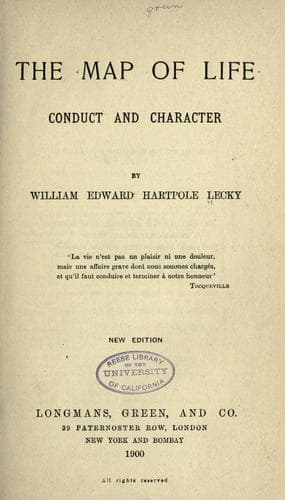
The Map of Life: Conduct and CharacterLecky, William Edward Hartpole
Philosophy
The Map of Life: Conduct and Character
Lecky, William Edward Hartpole
Character; Conduct of life
The preference, however, to be given to old charities rather than to new
ones is subject to very many exceptions. It does not apply to new
countries or to the many cases in which changes and developments of
industry have planted vast agglomerations of population in districts
which were once but thinly populated, and therefore but little provided
with charitable or educational institutions. Nor does it apply to the
many cases in which the circumstances of modern life have called into
existence new forms of charity, new wants, new dangers and evils to be
combated, new departments of knowledge to be cultivated. One of the
greatest difficulties of the older universities is that of providing,
out of their shrinking endowments, for the teaching of branches of
science and knowledge which have only come into existence, or at least
into prominence, long after these universities were established, and
some of which require not only trained teachers but costly apparatus
and laboratories. Increasing international competition and enlarged
scientific knowledge have rendered necessary an amount of technical and
agricultural education never dreamed of by our ancestors; and the rise
of the great provincial towns and the greater intensity of provincial
life and provincial patriotism, as well as the changes that have passed
over the position both of the working and middle classes, have created a
genuine demand for educational establishments of a different type from
the older universities. The higher education of women is essentially a
nineteenth-century work, and it has been carried on without the
assistance of old endowments and with very little help from modern
Parliaments. In the distribution of public funds a class which is wholly
unrepresented in Parliament seldom gets its fair share; and higher
education, like most forms of science, like most of the higher forms of
literature, and like many valuable forms of research, never can be
self-supporting. There are great branches of knowledge which without
established endowments must remain uncultivated, or be cultivated only
by men of considerable private means. Some invaluable curative agencies,
such as convalescent homes in different countries and climates and for
different diseases, have grown up in our own generation, as well as some
of the most fruitful forms of medical research and some of the most
efficacious methods of giving healthy change and brightness to the lives
that are most monotonous and overstrained. Every great revolution in
industry, in population, and even in knowledge, brings with it new and
special wants, and there are cases in which assisted emigration is one
of the best forms of charity.
Public-domain text, read in full here on John Shaqi.
Reviews
Reviews
No reviews yet
Be the first to share your thoughts on this work.
Elsewhere in the archive
Join the Discussion
Join the discussion
Sign in to leave a comment or review.
Sign InorCreate an account