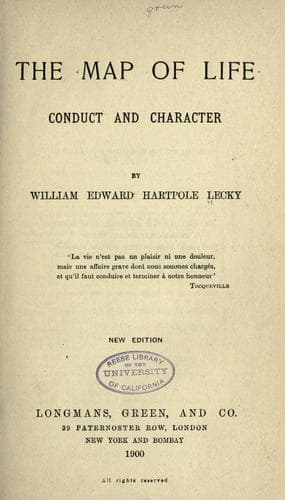
The Map of Life: Conduct and CharacterLecky, William Edward Hartpole
Philosophy
The Map of Life: Conduct and Character
Lecky, William Edward Hartpole
Character; Conduct of life
Such men have great power, and, if their philanthropic expenditure is
wisely guided, it may be of incalculable benefit. I have already
indicated many of the channels in which it may safely flow, but one or
two additional hints on the subject may not be useless. Perhaps as a
general rule these men will find that they can act most wisely by
strengthening and enlarging old charities which are really good, rather
than by founding new ones. Competition is the soul of industry, but
certainly not of charity, and there is in England a deplorable waste of
money and machinery through the excessive multiplication of institutions
intended for the same objects. The kind of ambition to which I have just
referred tends to make men prefer new charities which can be identified
with their names; the paid officials connected with charities have
become a large and powerful profession, and their influence is naturally
used in the same direction; the many different religious bodies in the
country often refuse to combine, and each desires to have its own
institutions; and there are fashions in charity which, while they
greatly stimulate generosity, have too often the effect of diverting it
from the older and more unobtrusive forms. On the other hand, one of the
most important facts in our present economical condition is that an
extraordinary and almost unparalleled development of industrial
prosperity has been accompanied by extreme and long-continued
agricultural depression and by a great fall in the rate of interest.
Wealth in many forms is accumulating with wonderful rapidity, and the
increased rate of wages is diffusing prosperity among the working
classes; but those who depend directly or indirectly on agricultural
rents or on interest of money invested in trust securities have been
suffering severely, and they comprise some of the most useful,
blameless, and meritorious classes in the community. The same causes
that have injured them have fallen with crushing severity on
old-established institutions which usually derive their income largely
or entirely from the rent of land or from money invested in the public
funds. The bitter cry of distress that is rising from the hospitals and
many other ancient charities, from the universities, from the clergy of
the Established Church, abundantly proves it.
Public-domain text, read in full here on John Shaqi.
Reviews
Reviews
No reviews yet
Be the first to share your thoughts on this work.
Elsewhere in the archive
Join the Discussion
Join the discussion
Sign in to leave a comment or review.
Sign InorCreate an account