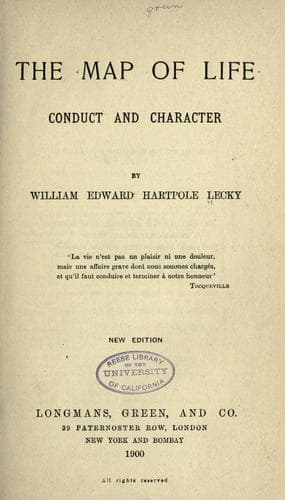
The Map of Life: Conduct and CharacterLecky, William Edward Hartpole
Philosophy
The Map of Life: Conduct and Character
Lecky, William Edward Hartpole
Character; Conduct of life
The greatly increased importance which the Darwinian theory has given to
heredity should tend to make men more sensible of the first of these
duties. In marriage there are not only reciprocal duties between the two
partners; there are also, more than in any other act of life, plain
duties to the race. The hereditary nature of insanity and of some forms
of disease is an indisputable truth. The hereditary transmission of
character has not, it is true, as yet acquired this position; and there
is a grave schism on the subject in the Darwinian school. But that it
exists to some extent few close observers will doubt, and it is in a
high degree probable that it is one of the most powerful moulding
influences of life. No more probable explanation has yet been given of
the manner in which human nature has been built up, and of the various
instincts and tastes with which we are born, than the doctrine that
habits and modes of thought and feeling indulged in and produced by
circumstances in former generations have gradually become innate in the
race, and exhibit themselves spontaneously and instinctively and quite
independently of the circumstances that originally produced them.
According to this theory the same process is continually going on. Man
has slowly emerged from a degraded and bestial condition. The pressure
of long-continued circumstances has moulded him into his special type;
but new feelings and habits, or modifications of old feelings and
habits, are constantly passing not only into his life but into his
nature, taking root there, and in some degree at least reproducing
themselves by the force of heredity in the innate disposition of his
offspring. If this be true, it gives a new and terrible importance both
to the duty of self-culture and to the duty of wise selection in
marriage. It means that children are likely to be influenced not only by
what we do and by what we say, but also by what we are, and that the
characters of the parents in different degrees and combinations will
descend even to a remote posterity.
It throws a not less terrible light upon the miscalculations of the
past. On this hypothesis, as Mr. Galton has truly shown, it is scarcely
possible to exaggerate the evil which has been brought upon the world by
the religious glorification of celibacy and by the enormous development
and encouragement of the monastic life. Generation after generation,
century after century, and over the whole wide surface of Christendom,
this conception of religion drew into a sterile celibacy nearly all who
were most gentle, most unselfish, most earnest, studious, and religious,
most susceptible to moral and intellectual enthusiasm, and thus
prevented them from transmitting to posterity the very qualities that
are most needed for the happiness and the moral progress of the race.
Whenever the good and evil resulting from different religious systems
come to be impartially judged, this consideration is likely to weigh
heavily in the scale.[70]
Public-domain text, read in full here on John Shaqi.
Reviews
Reviews
No reviews yet
Be the first to share your thoughts on this work.
Elsewhere in the archive