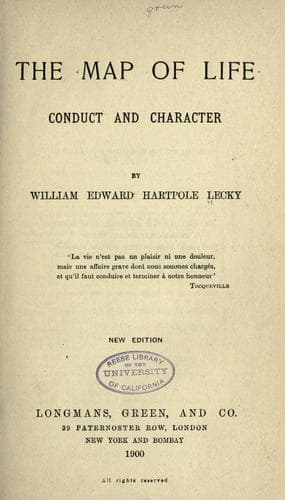
The Map of Life: Conduct and CharacterLecky, William Edward Hartpole
Philosophy
The Map of Life: Conduct and Character
Lecky, William Edward Hartpole
Character; Conduct of life
Returning, however, to the narrower sphere of particular marriages, it
may be observed that although full confidence, and, in one sense,
complete identification of interests, are the characteristics of a
perfect marriage, this does not by any means imply that one partner
should be a kind of duplicate of the other. Woman is not a mere weaker
man; and the happiest marriages are often those in which, in tastes,
character, and intellectual qualities, the wife is rather the complement
than the reflection of her husband. In intellectual things this is
constantly shown. The purely practical and prosaic intellect is united
with an intellect strongly tinged with poetry and romance; the man whose
strength is in facts, with the woman whose strength is in ideas; the man
who is wholly absorbed in science or politics or economical or
industrial problems and pursuits, with a woman who possesses the talent
or at least the temperament of an artist or musician. In such cases one
partner brings sympathies or qualities, tastes or appreciations or kinds
of knowledge in which the other is most defective; and by the close and
constant contact of two dissimilar types each is, often insensibly, but
usually very effectually, improved. Men differ greatly in their
requirements of intellectual sympathy. A perfectly commonplace
intellectual surrounding will usually do something to stunt or lower a
fine intelligence, but it by no means follows that each man finds the
best intellectual atmosphere to be that which is most in harmony with
his own special talent.
To many, hard intellectual labour is an eminently isolated thing, and
what they desire most in the family circle is to cast off all thought of
it. I have known two men who were in the first rank of science, intimate
friends, and both of them of very domestic characters. One of them was
accustomed to do nearly all his work in the presence of his wife, and in
the closest possible co-operation with her. The other used to
congratulate himself that none of his family had his own scientific
tastes, and that when he left his work and came into his family circle
he had the rest of finding himself in an atmosphere that was entirely
different. Some men of letters need in their work constant stimulus,
interest, and sympathy. Others desire only to develop their talent
uncontrolled, uninfluenced, and undisturbed, and with an atmosphere of
cheerful quiet around them.
Public-domain text, read in full here on John Shaqi.
Reviews
Reviews
No reviews yet
Be the first to share your thoughts on this work.
Elsewhere in the archive
Join the Discussion
Join the discussion
Sign in to leave a comment or review.
Sign InorCreate an account