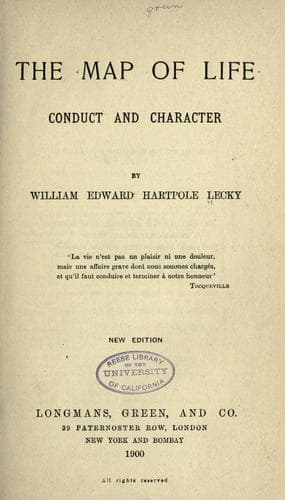
The Map of Life: Conduct and CharacterLecky, William Edward Hartpole
Philosophy
The Map of Life: Conduct and Character
Lecky, William Edward Hartpole
Character; Conduct of life
On such matters, however, generalisations have little value, as
exceptions are very numerous. Differences of character, age, experience,
and judgment, and countless special circumstances, will modify the
family type, and it is in discovering these differences that wisdom in
marriage mainly consists. The directions in which married life may
influence character are also very many; but in the large number of cases
in which it brings with it a great weight of household cares and family
interests it will usually be found with both partners, but especially
with the woman, at once to strengthen and to narrow unselfishness. She
will live very little for herself, but very exclusively for her family.
On the intellectual side such marriages usually give a sounder judgment
and a wider knowledge of the world rather than purely intellectual
tastes. It is a good thing when the education which precedes marriage
not only prepares for the duties of the married life, but also furnishes
a fair share of the interests and tastes which that state will probably
tend to weaken. The hard battle of life, and the anxieties and sorrows
that a family seldom fails to bring, will naturally give an increased
depth and seriousness to character. There are, however, natures which,
though they may be tainted by no grave vice, are so incurably frivolous
that even this education will fail to influence them. As Emerson says,
'A fly is as untameable as a hyæna.'
The age that is most suited for marriage is also a matter which will
depend largely on individual circumstances. The ancients, as is well
known, placed it, in the case of the man, far back, and they desired a
great difference of age between the man and the woman. Plato assigned
between thirty and thirty-five, and Aristotle thirty-seven, as the best
age for a man to marry, while they would have the girls married at
eighteen or twenty.[71] In their view, however, marriage was looked
upon very exclusively from the side of the man and of the State. They
looked on it mainly as the means of producing healthy citizens, and it
was in their eyes almost wholly dissociated from the passion of love.
Montaigne, in one of his essays, has expounded this view with the
frankest cynicism.[72] Yet few things are so important in marriage as
that the man should bring into it the freshness and the purity of an
untried nature, and that the early poetry and enthusiasm of life should
at least in some degree blend with the married state. Nor is it
desirable that a relation in which the formation of habits plays so
large a part should be deferred until character has lost its
flexibility, and until habits have been irretrievably hardened.
Public-domain text, read in full here on John Shaqi.
Reviews
Reviews
No reviews yet
Be the first to share your thoughts on this work.
Elsewhere in the archive
Join the Discussion
Join the discussion
Sign in to leave a comment or review.
Sign InorCreate an account