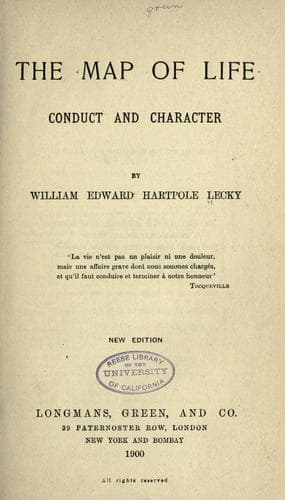
The Map of Life: Conduct and CharacterLecky, William Edward Hartpole
Philosophy
The Map of Life: Conduct and Character
Lecky, William Edward Hartpole
Character; Conduct of life
What is true of intellect is also in a large degree true of character.
Two persons living constantly together should have many tastes and
sympathies in common, and their characters will in most cases tend to
assimilate. Yet great disparities of character may subsist in marriage,
not only without evil but often with great advantage. This is especially
the case where each supplies what is most needed in the other. Some
natures require sedatives and others tonics; and it will often be found
in a happy marriage that the union of two dissimilar natures stimulates
the idle and inert, moderates the impetuous, gives generosity to the
parsimonious and order to the extravagant, imparts the spirit of caution
or the spirit of enterprise which is most needed, and corrects, by
contact with a healthy and cheerful nature, the morbid and the
desponding.
Marriage may also very easily have opposite effects. It is not
unfrequently founded on the sympathy of a common weakness, and when this
is the case it can hardly fail to deepen the defect. On the whole,
women, in some of the most valuable forms of strength--in the power of
endurance and in the power of perseverance--are at least the equals of
men. But weak and tremulous nerves, excessive sensibility, and an
exaggerated share of impulse and emotion, are indissolubly associated
with certain charms, both of manner and character, which are intensely
feminine, and to many men intensely attractive. When a nature of this
kind is wedded to a weak or a desponding man, the result will seldom be
happiness to either party, but with a strong man such marriages are
often very happy. Strength may wed with weakness or with strength, but
weakness should beware of mating itself with weakness. It needs the oak
to support the ivy with impunity, and there are many who find the
constant contact of a happy and cheerful nature the first essential of
their happiness.
As it is not wise or right that either partner in marriage should lose
his or her individuality, so it is right that each should have an
independent sphere of authority. It is assumed, of course, that there is
the perfect trust which should be the first condition of marriage and
also a reasonable judgment. Many marriages have been permanently marred
because the woman has been given no independence in money matters and is
obliged to come for each small thing to her husband. In general the less
the husband meddles in household matters, or the wife in professional
ones, the better. The education of very young children of both sexes,
and of girls of a mature age, will fall almost exclusively to the wife.
The education of the boys when they have emerged from childhood will be
rather governed by the judgment of the man. Many things will be
regulated in common; but the larger interests of the family will usually
fall chiefly to one partner, the smaller and more numerous ones to the
other.
Public-domain text, read in full here on John Shaqi.
Reviews
Reviews
No reviews yet
Be the first to share your thoughts on this work.
Elsewhere in the archive
Join the Discussion
Join the discussion
Sign in to leave a comment or review.
Sign InorCreate an account