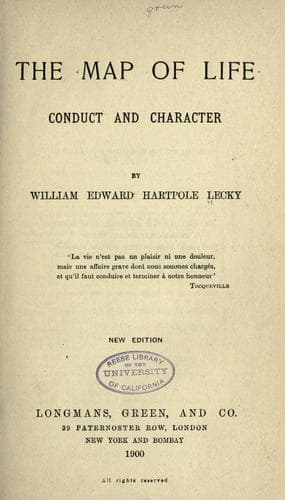
The Map of Life: Conduct and CharacterLecky, William Edward Hartpole
Philosophy
The Map of Life: Conduct and Character
Lecky, William Edward Hartpole
Character; Conduct of life
It is also a curious thing to observe how often, when the saving gift of
tact is wanting, the brilliant, the witty, the ambitious, and the
energetic are passed in the race of life by men who in intellectual
qualities are greatly their inferiors. They dazzle, agitate, and in a
measure influence, and they easily win places in the second rank; but
something in the very exercise of their talents continually trammels
them, while judgment, tact, and good-nature, with comparatively little
brilliancy, quietly and unobtrusively take the helm. There is the
excellent talker who, by his talents and his acquirements, is eminently
fitted to delight and to instruct, yet he is so unable to repress some
unseemly jest or some pointed sarcasm or some humorous paradox that he
continually leaves a sting behind him, creates enemies, destroys his
reputation for sobriety of thought, and makes himself impossible in
posts of administration and trust. There is the parliamentary speaker
who, amid shouts of applause, pursues his adversary with scathing
invective or merciless ridicule, and who all the time is accumulating
animosities against himself, shutting the door against combinations that
would be all important to his career, and destroying his chances of
party leadership. There is the advocate who can state his case with
consummate power, but who, by an aggressive manner or a too evident
contempt for his adversary, or by the over-statement of a good cause,
habitually throws the minds of his hearers into an attitude of
opposition. There are the many men who, by ill-timed or too frequent
levity, lose all credit for their serious qualities, or who by
pretentiousness or self-assertion or restless efforts to distinguish
themselves, make themselves universally disliked, or who by their
egotism or their repetitions or their persistence, or their incapacity
of distinguishing essentials from details, or understanding the
dispositions of others, or appreciating times and seasons, make their
wearied and exasperated hearers blind to the most substantial merits. By
faults of tact men of really moderate opinions get the reputation of
extremists; men of substantially kindly natures sow animosities
wherever they go; men of real patriotism are regarded as mere jesters or
party gamblers; men who possess great talents and have rendered great
services to the world sink into inveterate bores and never obtain from
their contemporaries a tithe of the success which is their due. Tact is
not merely shown in saying the right thing at the right time and to the
right people; it is shown quite as much in the many things that are left
unsaid and apparently unnoticed, or are only lightly and evasively
touched.
Public-domain text, read in full here on John Shaqi.
Reviews
Reviews
No reviews yet
Be the first to share your thoughts on this work.
Elsewhere in the archive
Join the Discussion
Join the discussion
Sign in to leave a comment or review.
Sign InorCreate an account