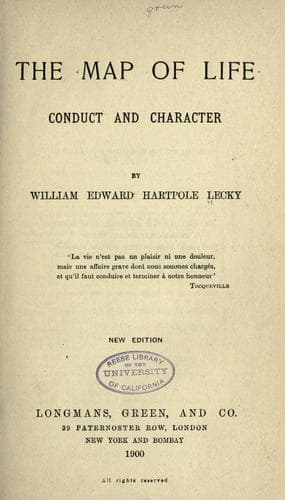
The Map of Life: Conduct and CharacterLecky, William Edward Hartpole
Philosophy
The Map of Life: Conduct and Character
Lecky, William Edward Hartpole
Character; Conduct of life
The combination of qualities which, though not absolutely incompatible,
are very usually disconnected, is the secret of many successful lives.
Thus, to take one of the most homely, but one of the most useful and
most pleasing of all qualities--good-nature--it will too often be found
that when it is the marked and leading feature of a character it is
accompanied by some want of firmness, energy, and judgment. Sometimes,
however, this is not the case, and there are then few greater elements
of success. It is curious to observe the subtle, magnetic sympathy by
which men feel whether their neighbour is a harsh or a kind judge of
others, and how generally those who judge harshly are themselves harshly
judged, while those who judge others rather by their merits than by
their defects, and perhaps a little above their merits, win popularity.
No one, indeed, can fail to notice the effect of good-nature in
conciliating opposition, securing attachment, smoothing the various
paths of life, and, it must be added, concealing grave faults. Laxities
of conduct that might well blast the reputation of a man or a woman are
constantly forgotten, or at least forgiven, in those who lead a life of
tactful good-nature, and in the eyes of the world this quality is more
valued than others of far higher and more solid worth. It is not
unusual, for example, to see a lady in society, who is living wholly or
almost wholly for her pleasures, who has no high purpose in life, no
real sense of duty, no capacity for genuine and serious self-sacrifice,
but who at the same time never says an unkind thing of her neighbours,
sets up no severe standard of conduct either for herself or for others,
and by an innate amiability of temperament tries, successfully and
without effort, to make all around her cheerful and happy. She will
probably be more admired, she will almost certainly be more popular,
than her neighbour whose whole life is one of self-denial for the good
of others, who sacrifices to her duties her dearest pleasures, her time,
her money, and her talents, but who through some unhappy turn of temper,
strengthened perhaps by a narrow and austere education, is a harsh and
censorious judge of the frailties of her fellows.
Public-domain text, read in full here on John Shaqi.
Reviews
Reviews
No reviews yet
Be the first to share your thoughts on this work.
Elsewhere in the archive
Join the Discussion
Join the discussion
Sign in to leave a comment or review.
Sign InorCreate an account