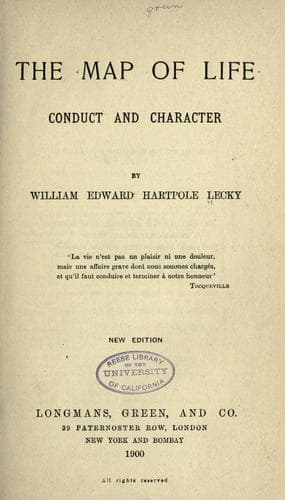
The Map of Life: Conduct and CharacterLecky, William Edward Hartpole
Philosophy
The Map of Life: Conduct and Character
Lecky, William Edward Hartpole
Character; Conduct of life
are sad, and the least sad is a speedy and painless end. When the eye
has ceased to see and the ear to hear, when the mind has failed and all
the friends of youth are gone, and the old man's life becomes a burden
not only to himself but to those about him, it is far better that he
should quit the scene. If a natural clinging to life, or a natural
shrinking from death, prevents him from clearly realising this, it is at
least fully seen by all others.
Nor, indeed, does this love of life in most cases of extreme old age
greatly persist. Few things are sadder than to see the young, or those
in mature life, seeking, according to the current phrase, to find means
of "killing time." But in extreme old age, when the power of work, the
power of reading, the pleasures of society, have gone, this phrase
acquires a new significance. As Madame de Staël has beautifully said,
'On dépose fleur à fleur la couronne de la vie.' An apathy steals over
every faculty, and rest--unbroken rest--becomes the chief desire. I
remember a touching epitaph in a German churchyard: 'I will arise, O
Christ, when Thou callest me; but oh! let me rest awhile, for I am very
weary.'
After all that can be said, most men are reluctant to look Time in the
face. The close of the year or a birthday is to them merely a time of
revelry, into which they enter in order to turn away from depressing
thought. They shrink from what seems to them the dreary truth, that they
are drifting to a dark abyss. To many the milestones along the path of
life are tombstones, every epoch being mainly associated in their
memories with a death. To some, past time is nothing--a closed chapter
never to be reopened.
The past is nothing, and at last,
The future can but be the past.
To others, the thought of the work achieved in the vanished years is the
most real and abiding of their possessions. They can feel the force of
the noble lines of Dryden:
Not Heaven itself upon the past has power,
But what has been has been, and I have had my hour.
He who would look Time in the face without illusion and without fear
should associate each year as it passes with new developments of his
nature; with duties accomplished, with work performed. To fill the time
allotted to us to the brim with action and with thought is the only way
in which we can learn to watch its passage with equanimity.
FOOTNOTES:
[74] Monte-Naken.
[75] See _The Mystery of Sleep_, by John Bigelow.
[76] Seneca, _de Brevitate Vitæ_, cap. XX.
CHAPTER XVII
'THE END'
Public-domain text, read in full here on John Shaqi.
Reviews
Reviews
No reviews yet
Be the first to share your thoughts on this work.
Elsewhere in the archive
Join the Discussion
Join the discussion
Sign in to leave a comment or review.
Sign InorCreate an account