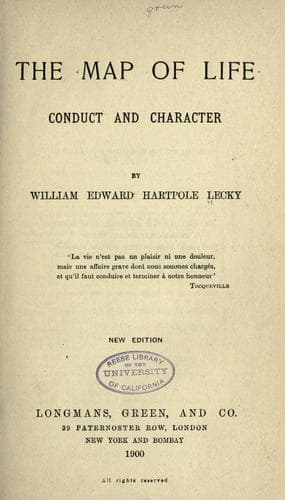
The Map of Life: Conduct and CharacterLecky, William Edward Hartpole
Philosophy
The Map of Life: Conduct and Character
Lecky, William Edward Hartpole
Character; Conduct of life
It is easy to conceive circumstances not widely different from those of
actual life that would, if not altogether, at least very largely, take
from death the gloom that commonly surrounds it. If all the members of
the human race died either before two or after seventy; if death was in
all cases the swift and painless thing that it is with many; and if the
old man always left behind him children to perpetuate his name, his
memory, and his thoughts, Death, though it might still seem a sad thing,
would certainly not excite the feelings it now so often produces. Of all
the events that befall us, it is that which owes most of its horror not
to itself, but to its accessories, its associations, and to the
imaginations that cluster around it. 'Death,' indeed, as a great stoical
moralist said, 'is the only evil that can never touch us. When we are,
death is not. When death comes, we are not.'
The composition of treatises of consolation intended to accustom men to
contemplate death without terror was one of the favourite exercises of
the philosophers in the Augustan and in the subsequent periods of Pagan
Rome. The chapter which Cicero has devoted to this subject in his
treatise on old age is a beautiful example of how it appeared to a
virtuous pagan, who believed in a future life which would bring him into
communion with those whom he had loved and lost on earth, but who at the
same time recognised this only as a probability, not a certainty.
"Death," he said, 'is an event either utterly to be disregarded if it
extinguish the soul's existence, or much to be wished if it convey her
to some region where she shall continue to exist for ever. One of these
two consequences must necessarily follow the disunion of soul and body;
there is no other possible alternative. What then have I to fear if
after death I shall either not be miserable or shall certainly be
happy?'
Vague notions, however, of a dim, twilight, shadowy world where the
ghosts of the dead lived a faint and joyless existence, and whence they
sometimes returned to haunt the living in their dreams, were widely
spread through the popular imaginations, and it was as the extinction of
all superstitious fears that the school of Lucretius and Pliny welcomed
the belief that all things ended with death--'Post mortem nihil est,
ipsaque mors nihil.' Nor is it by any means certain that even in the
school of Plato the thought of another life had a great and operative
influence on minds and characters. Death was chiefly represented as
rest; as the close of a banquet; as the universal law of nature which
befalls all living beings, though the immense majority encounter it at
an earlier period than man. It was thought of simply as
sleep--dreamless, undisturbed sleep--the final release from all the
sorrows, sufferings, anxieties, labours, and longings of life.
We are such stuff
As dreams are made on, and our little life
Is rounded with a sleep.[77]
Public-domain text, read in full here on John Shaqi.
Reviews
Reviews
No reviews yet
Be the first to share your thoughts on this work.
Elsewhere in the archive
Join the Discussion
Join the discussion
Sign in to leave a comment or review.
Sign InorCreate an account