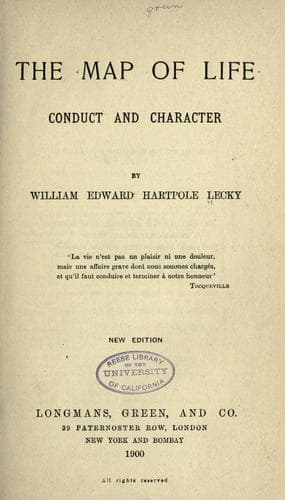
The Map of Life: Conduct and CharacterLecky, William Edward Hartpole
Philosophy
The Map of Life: Conduct and Character
Lecky, William Edward Hartpole
Character; Conduct of life
You find yourself in the presence of what is a far deeper and more
poignant trial than an old man's death--a young life cut off in its
prime; the eclipse of a sun before the evening has arrived. Accustom
yourself to consider the life that has passed as a whole. A human being
has been called into the world--has lived in it ten, twenty, thirty
years. It seems to you an intolerable instance of the injustice of fate
that he is so early cut off. Estimate, then, that life as a whole, and
ask yourself whether, so judged, it has been a blessing or the reverse.
Count up the years of happiness. Count up the days, or perhaps weeks, of
illness and of pain. Measure the happiness that this short life has
given to some who have passed away; who never lived to see its early
close. Balance the happiness which during its existence it gave to those
who survived, with the poignancy and the duration of pain caused by the
loss. Here, for example, is one who lived perhaps twenty-five years in
health and vigour; whose life during that period was chequered by no
serious misfortune; whose nature, though from time to time clouded by
petty anxieties and cares, was on the whole bright, buoyant, and happy;
who had the capacity of vivid enjoyment and many opportunities of
attaining it; who felt all the thrill of health and friendship and
ecstatic pleasure. Then came a change,--a year or two with a crippled
wing--life, though not abjectly wretched, on the whole a burden, and
then the end. You can easily conceive--you can ardently desire--a better
lot, but judge fairly the lights and shades of what has been. Does not
the happiness on the whole exceed the evil? Can you honestly say that
this life has been a curse and not a blessing?--that it would have been
better if it had never been called out of nothingness?--that it would
have been better if the drama had never been played? It is over now. As
you lay in his last home the object of so much love, ask yourself
whether, even in a mere human point of view, this parenthesis between
two darknesses has not been on the whole productive of more happiness
than pain to him and to those around him.
Public-domain text, read in full here on John Shaqi.
Reviews
Reviews
No reviews yet
Be the first to share your thoughts on this work.
Elsewhere in the archive
Join the Discussion
Join the discussion
Sign in to leave a comment or review.
Sign InorCreate an account