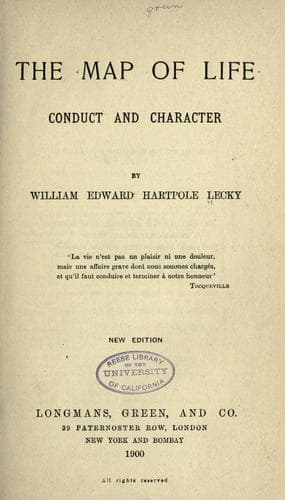
The Map of Life: Conduct and Character — John Shaqi
The Map of Life: Conduct and CharacterLecky, William Edward Hartpole
Philosophy
The Map of Life: Conduct and Character
Lecky, William Edward Hartpole
Character; Conduct of life
There are other ages in which military life is looked upon by moralists
with disfavour, and in which patriotism ranks very low in the scale of
virtues, while charity, gentleness, self-abnegation, devotional habits,
and purity in thought, word and act are pre-eminently inculcated. The
intellectual virtues, again, which deal with truth and falsehood, form a
distinct group. The habit of mind which makes men love truth for its own
sake as the supreme ideal, and which turns aside from all falsehood,
exaggeration, party or sectarian misrepresentation and invention, is in
no age a common one, but there are some ages in which it is recognised
and inculcated as virtue, while there are others in which it is no
exaggeration to say that the whole tendency of religious teaching has
been to discourage it. During many centuries the ascetic and purely
ecclesiastical standard of virtue completely dominated. The domestic
virtues, though clearly recognised, held altogether a subordinate place
to what were deemed the higher virtues of the ascetic celibate.
Charity, though nobly cultivated and practised, was regarded mainly
through a dogmatic medium and practised less for the benefit of the
recipient than for the spiritual welfare of the donor.
In the eyes of multitudes the highest conception of a saintly life
consisted largely if not mainly in complete detachment from secular
interests and affections. No type was more admired, and no type was ever
more completely severed from all active duties and all human relations
than that of the saint of the desert or of the monk of one of the
contemplative orders. To die to the world; to become indifferent to its
aims, interests and pleasures; to measure all things by a standard
wholly different from human happiness, to live habitually for another
life was the constant teaching of the saints. In the stress laid on the
cultivation of the spiritual life the whole sphere of active duties sank
into a lower plane; and the eye of the mind was turned upwards and
inwards and but little on the world around. 'Happy,' said one saint, 'is
the mind which sees but two objects, God and self, one of which
conceptions fills it with a sovereign delight and the other abases it to
the extremest dejection.'[11] 'As much love as we give to creatures,'
said another saint, 'just so much we steal from the Creator.'[12] 'Two
things only do I ask,' said a third,[13] 'to suffer and to die.'
'Forsake all,' said Thomas à Kempis, 'and thou shalt find all. Leave
desire and thou shalt find rest.' 'Unless a man be disengaged from the
affection of all creatures he cannot with freedom of mind attend unto
Divine things.'
Public-domain text, read in full here on John Shaqi.
Reviews
Reviews
No reviews yet
Be the first to share your thoughts on this work.
Join the Discussion
Join the discussion
Sign in to leave a comment or review.
Sign InorCreate an account