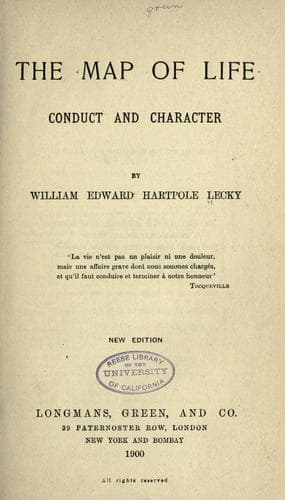
The Map of Life: Conduct and CharacterLecky, William Edward Hartpole
Philosophy
The Map of Life: Conduct and Character
Lecky, William Edward Hartpole
Character; Conduct of life
A more recognised, though probably not really more pernicious example of
false ideals, is to be found in the glorification of the _demi-monde_,
which is so conspicuous in some societies and literatures. In a healthy
state of opinion, the public, ostentatious appearance of such persons,
without any concealment of their character, in the great concourse of
fashion and among the notabilities of the State, would appear an
intolerable scandal, and it becomes much worse when they give the tone
to fashion and become the centres and the models of large and by no
means undistinguished sections of Society. The evils springing from this
public glorification of the class are immeasurably greater than the
evils arising from its existence. The standard of popular morals is
debased. Temptation in its most seductive form is forced upon
inflammable natures, and the most pernicious of all lessons is taught to
poor, honest, hard-working women. It is indeed wonderful that in
societies where this evil prevails so much virtue should still exist
among graceful, attractive women of the shopkeeping and servant class
when they continually see before them members of their own class, by
preferring vice to virtue, rising at once to wealth, luxury and
idleness, and even held up as objects of admiration or imitation.
In judging wisely the characters of men, one of the first things to be
done is to understand their ideals. Try to find out what kind of men or
of life; what qualities, what positions seem to them the most desirable.
Men do not always fully recognise their own ideals, for education and
the conventionalities of Society oblige them to assert a preference for
that which may really have no root in their minds. But by a careful
examination it is usually possible to ascertain what persons or
qualities or circumstances or gifts exercise a genuine, spontaneous,
magnetic power over them--whether they really value supremely rank or
position, or money, or beauty, or intellect, or superiority of
character. If you know the ideal of a man you have obtained a true key
to his nature. The broad lines of his character, the permanent
tendencies of his imagination, his essential nobility or meanness, are
thus disclosed more effectually than by any other means. A man with high
ideals, who admires wisely and nobly, is never wholly base though he may
fall into great vices. A man who worships the baser elements is in truth
an idolater though he may have never bowed before an image of stone.
Public-domain text, read in full here on John Shaqi.
Reviews
Reviews
No reviews yet
Be the first to share your thoughts on this work.
Elsewhere in the archive
Join the Discussion
Join the discussion
Sign in to leave a comment or review.
Sign InorCreate an account