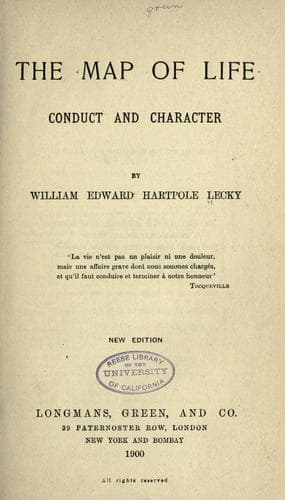
The Map of Life: Conduct and CharacterLecky, William Edward Hartpole
Philosophy
The Map of Life: Conduct and Character
Lecky, William Edward Hartpole
Character; Conduct of life
The human mind has much more power of distinguishing between right and
wrong, and between true and false, than of estimating with accuracy the
comparative gravity of opposite evils. It is nearly always right in
judging between right and wrong. It is generally wrong in estimating
degrees of guilt, and the root of its error lies in the extreme
difficulty of putting ourselves into the place of those whose characters
or circumstances are radically different from our own. This want of
imagination acts widely on our judgment of what is good as well as of
what is bad. Few men have enough imagination to realise types of
excellence altogether differing from their own. It is this, much more
than vanity, that leads them to esteem the types of excellence to which
they themselves approximate as the best, and tastes and habits that are
altogether incongruous with their own as futile and contemptible. It is,
perhaps, most difficult of all to realise the difference of character
and especially of moral sensibility produced by a profound difference of
circumstances. This difficulty largely falsifies our judgments of the
past, and it is the reason why a powerful imagination enabling us to
realise very various characters and very remote circumstances is one of
the first necessities of a great historian. Historians rarely make
sufficient allowance for the degree in which the judgments and
dispositions even of the best men are coloured by the moral tone of the
time, society and profession in which they lived. Yet it is probable
that on the whole we estimate more justly the characters of the past
than of the present. No one would judge the actions of Charlemagne or of
his contemporaries by the strict rules of nineteenth-century ethics. We
feel that though they committed undoubted crimes, these crimes are at
least indefinitely less heinous than they would have been under the
wholly different circumstances and moral atmosphere of our own day. Yet
we seldom apply this method of reasoning to the different strata of the
same society. Men who have been themselves brought up amid all the
comforts and all the moralising and restraining influences of a refined
society, will often judge the crimes of the wretched pariahs of
civilisation as if their acts were in no degree palliated by their
position. They say to themselves 'How guilty should I have been if I
had done this thing,' and their verdict is quite just according to this
statement of the case. They realise the nature of the act. They utterly
fail to realise the character and circumstances of the actor.
Public-domain text, read in full here on John Shaqi.
Reviews
Reviews
No reviews yet
Be the first to share your thoughts on this work.
Elsewhere in the archive
Join the Discussion
Join the discussion
Sign in to leave a comment or review.
Sign InorCreate an account