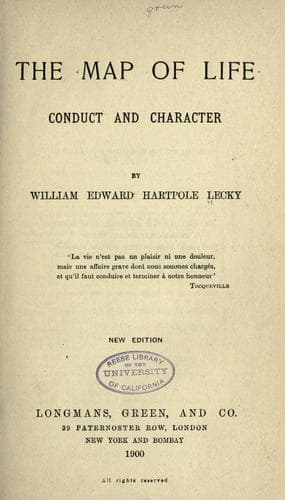
The Map of Life: Conduct and CharacterLecky, William Edward Hartpole
Philosophy
The Map of Life: Conduct and Character
Lecky, William Edward Hartpole
Character; Conduct of life
Imperfect, however, as is our power of judging others, it is a power we
are all obliged to exercise. It is impossible to exclude the
considerations of moral guilt and of palliating or aggravating
circumstances from the penal code, and from the administration of
justice, though it cannot be too clearly maintained that the criminal
code is not coextensive with the moral code, and that many things which
are profoundly immoral lie beyond its scope. On the whole it should be
as much as possible confined to acts by which men directly injure
others. In the case of adult men, private vices, vices by which no one
is directly affected, except by his own free will, and in which the
elements of force or fraud are not present, should not be brought within
its range. This ideal, it is true, cannot be fully attained. The
legislator must take into account the strong pressure of public opinion.
It is sometimes true that a penal law may arrest, restrict, or prevent
the revival of some private vice without producing any countervailing
evil. But the presumption is against all laws which punish the voluntary
acts of adult men when those acts injure no one except themselves. The
social censure, or the judgment of opinion, rightly extends much
further, though it is often based on very imperfect knowledge or
realisation. It is probable that, on the whole, opinion judges too
severely the crimes of passion and of drink, as well as those which
spring from the pressure of great poverty and are accompanied by great
ignorance. The causes of domestic anarchy are usually of such an
intimate nature and involve so many unknown or imperfectly realised
elements of aggravation or palliation that in most cases the less men
attempt to judge them the better. On the other hand, public opinion is
usually far too lenient in judging crimes of ambition, cupidity, envy,
malevolence, and callous selfishness; the crimes of ill-gotten and
ill-used wealth, especially in the many cases in which those crimes are
unpunished by law.
Public-domain text, read in full here on John Shaqi.
Reviews
Reviews
No reviews yet
Be the first to share your thoughts on this work.
Elsewhere in the archive
Join the Discussion
Join the discussion
Sign in to leave a comment or review.
Sign InorCreate an account