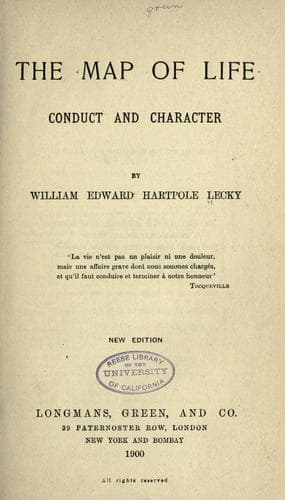
The Map of Life: Conduct and CharacterLecky, William Edward Hartpole
Philosophy
The Map of Life: Conduct and Character
Lecky, William Edward Hartpole
Character; Conduct of life
It is a mere commonplace of morals that in the path of evil it is the
first step that costs the most. The shame, the repugnance, and the
remorse which attend the first crime speedily fade, and on every
repetition the habit of evil grows stronger. A process of the same kind
passes over our judgments. Few things are more curious than to observe
how the eye accommodates itself to a new fashion of dress, however
unbecoming; how speedily men, or at least women, will adopt a new and
artificial standard and instinctively and unconsciously admire or blame
according to this standard and not according to any genuine sense of
beauty or the reverse. Few persons, however pure may be their natural
taste, can live long amid vulgar and vulgarising surroundings without
losing something of the delicacy of their taste and learning to
accept--if not with pleasure, at least with acquiescence--things from
which under other circumstances they would have recoiled. In the same
way, both individuals and societies accommodate themselves but too
readily to lower moral levels, and a constant vigilance is needed to
detect the forms or directions in which individual and national
character insensibly deteriorate.
FOOTNOTE:
[23] See Ribot, _Les Maladies de la Volonté_, pp. 92, 116-119.
CHAPTER VII
It is impossible for a physician to prescribe a rational regimen for a
patient unless he has formed some clear conception of the nature of his
constitution and of the morbid influences to which it is inclined; and
in judging the wisdom of various proposals for the management of
character we are at once met by the initial controversy about the
goodness or the depravity of human nature. It is a subject on which
extreme exaggerations have prevailed. The school of Rousseau, which
dominated on the Continent in the last half of the eighteenth century,
represented mankind as a being who comes into existence essentially
good, and it attributed all the moral evils of the world, not to any
innate tendencies to vice, but to superstition, vicious institutions,
misleading education, a badly organised society. It is an obvious
criticism that if human nature had been as good as such writers
imagined, these corrupt and corrupting influences could never have grown
up, or at least could never have obtained a controlling influence, and
this philosophy became greatly discredited when the French Revolution,
which it did so much to produce, ended in the unspeakable horrors of the
Reign of Terror and in the gigantic carnage of the Napoleonic wars. On
the other hand, there are large schools of theologians who represent man
as utterly and fundamentally depraved, 'born in corruption, inclined to
evil, incapable by himself of doing good;' totally wrecked and ruined
as a moral being by the catastrophe in Eden. There are also moral
philosophers--usually very unconnected with theology--who deny or
explain away all unselfish elements in human nature, represent man as
Public-domain text, read in full here on John Shaqi.
Reviews
Reviews
No reviews yet
Be the first to share your thoughts on this work.
Elsewhere in the archive
Join the Discussion
Join the discussion
Sign in to leave a comment or review.
Sign InorCreate an account