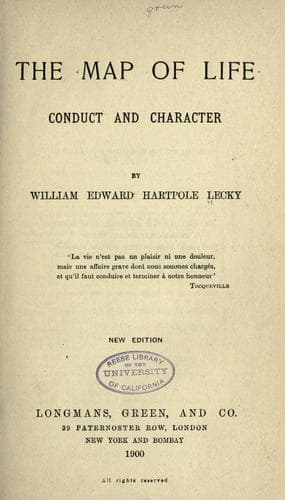
The Map of Life: Conduct and CharacterLecky, William Edward Hartpole
Philosophy
The Map of Life: Conduct and Character
Lecky, William Edward Hartpole
Character; Conduct of life
Considerations of this kind are sufficient to remedy the extreme
exaggeration of human corruption that may often be heard, but they are
not inconsistent with the truth that human nature is so far depraved
that it can never be safely left to develop unimpeded without strong
legal and social restraint. It is not necessary to seek examples of its
depravity within the precincts of a prison or in the many instances
that may be found outside the criminal population of morbid moral taints
which are often as clearly marked as physical disease. On a large scale
and in the actions of great bodies of men the melancholy truth is
abundantly displayed. On the whole Christianity has been far more
successful in influencing individuals than societies. The mere spectacle
of a battle-field with the appalling mass of hideous suffering
deliberately and ingeniously inflicted by man upon man should be
sufficient to scatter all idyllic pictures of human nature. It was once
the custom of a large school of writers to attribute unjust wars solely
to the rulers of the world, who for their own selfish ambitions
remorselessly sacrificed the lives of tens of thousands of their
subjects. Their guilt has been very great, but they would never have
pursued the course of ambitious conquest if the applause of nations had
not followed and encouraged them, and there are no signs that democracy,
which has enthroned the masses, has any real tendency to diminish war.
In modern times the danger of war lies less in the intrigues of
statesmen than in deeply seated international jealousies and
antipathies; in sudden, volcanic outbursts of popular passion. After
eighteen hundred years' profession of the creed of peace, Christendom is
an armed camp. Never, or hardly ever, in times of peace had the mere
preparations of war absorbed so large a proportion of its population and
resources, and very seldom has so large an amount of its ability been
mainly employed in inventing and in perfecting instruments of
destruction. Those who will look on the world without illusion will be
compelled to admit that the chief guarantees for its peace are to be
found much less in moral than in purely selfish motives. The financial
embarrassments of the great nations; their profound distrust of one
another; the vast cost of modern war; the gigantic commercial disasters
it inevitably entails; the extreme uncertainty of its issue; the utter
ruin that may follow defeat--these are the real influences that restrain
the tiger passions and the avaricious cravings of mankind. It is also
one of the advantages that accompany the many evils of universal
service, that great citizen armies who in time of war are drawn from
their homes, their families, and their peaceful occupations have not the
same thirst for battle that grows up among purely professional soldiers,
voluntarily enlisted and making a military life their whole career. Yet,
in spite of all this, what trust could be placed in the forbearance of
Public-domain text, read in full here on John Shaqi.
Reviews
Reviews
No reviews yet
Be the first to share your thoughts on this work.
Elsewhere in the archive
Join the Discussion
Join the discussion
Sign in to leave a comment or review.
Sign InorCreate an account