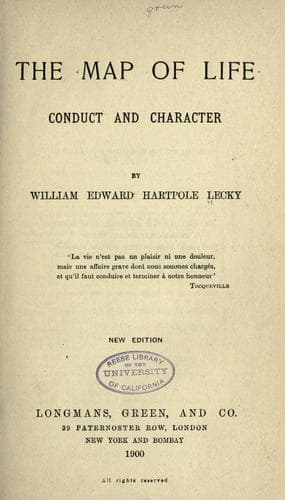
The Map of Life: Conduct and CharacterLecky, William Edward Hartpole
Philosophy
The Map of Life: Conduct and Character
Lecky, William Edward Hartpole
Character; Conduct of life
If we look again into the vice and sin that undoubtedly disfigure the
world we shall find much reason to believe that what is exceptional in
human nature is not the evil tendency but the restraining conscience,
and that it is chiefly the weakness of the distinctively human quality
that is the origin of the evil. It is impossible indeed, with the
knowledge we now possess, to deny to animals some measure both of reason
and of the moral sense. In addition to the higher instincts of parental
affection and devotion which are so clearly developed we find among some
animals undoubted signs of remorse, gratitude, affection,
self-sacrifice. Even the point of honour which attaches shame to some
things and pride to others may be clearly distinguished. No one who has
watched the more intelligent dog can question this, and many will
maintain that in some animals, though both good and bad qualities are
less widely developed than in man, the proportion of the good to the
evil is more favourable in the animal than in the man. At the same time
in the animal world desire is usually followed without any other
restraint than fear, while in man it is largely though no doubt very
imperfectly limited by moral self-control. Most crimes spring not from
anything wrong in the original and primal desire but from the
imperfection of this higher, distinct or superadded element in our
nature. The crimes of dishonesty and envy, when duly analysed, have at
their basis simply a desire for the desirable--a natural and inevitable
feeling. What is absent is the restraint which makes men refrain from
taking or trying to take desirable things that belong to another.
Sensual faults spring from a perfectly natural impulse, but the
restraint which confines the action of that impulse to defined
circumstances is wanting. Much, too, of the insensibility and hardness
of the world is due to a simple want of imagination which prevents us
from adequately realising the sufferings of others. The predatory,
envious and ferocious feelings that disturb mankind operate unrestrained
through the animal world, though man's superior intelligence gives his
desires a special character and a greatly increased scope, and
introduces them into spheres inconceivable to the animal. Immoderate and
uncontrolled desires are the root of most human crimes, but at the same
time the self-restraint that limits desire, or self-seeking, by the
rights of others, seems to be mainly, though not wholly, the prerogative
of man.
Public-domain text, read in full here on John Shaqi.
Reviews
Reviews
No reviews yet
Be the first to share your thoughts on this work.
Elsewhere in the archive
Join the Discussion
Join the discussion
Sign in to leave a comment or review.
Sign InorCreate an account