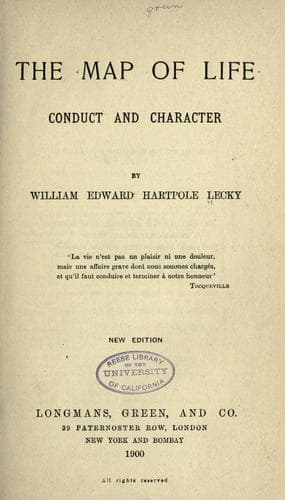
The Map of Life: Conduct and CharacterLecky, William Edward Hartpole
Philosophy
The Map of Life: Conduct and Character
Lecky, William Edward Hartpole
Character; Conduct of life
Considerations of this kind, if duly realised, bring out clearly the
insincerity and the unreality of much of our professed belief. Hardly
any sane man would desire to suppress Bank Holidays simply because they
are the occasion of a considerable number of cases of drunkenness which
would not otherwise have taken place. No humane legislator would
hesitate to suppress them if they produced an equal number of deaths or
other great physical calamities. This manner of measuring the relative
importance of things is not incompatible with a general acknowledgment
of the fact that there are many amusements which produce an amount of
moral evil that overbalances their advantages as sources of pleasure, or
of the great truth that the moral is the higher and ought to be the
ruling part of our being. But the realities of life cannot be measured
by rigid theological formulæ. Life is a scene in which different kinds
of interest not only blend but also modify and in some degree
counterbalance one another, and it can only be carried on by constant
compromises in which the lines of definition are seldom very clearly
marked, and in which even the highest interest must not altogether
absorb or override the others. We have to deal with good principles that
cannot be pushed to their full logical results; with varying standards
which cannot be brought under inflexible law.
Take, for example, the many untruths which the conventional courtesies
of Society prescribe. Some of these are so purely matter of phraseology
that they deceive no one. Others chiefly serve the purpose of courteous
concealment, as when they enable us to refuse a request or to decline an
invitation or a visit without disclosing whether disinclination or
inability is the cause. Then there are falsehoods for useful purposes.
Few men would shrink from a falsehood which was the only means of saving
a patient from a shock which would probably produce his death. No one, I
suppose, would hesitate to deceive a criminal if by no other means he
could prevent him from accomplishing a crime. There are also cases of
the suppression of what we believe to be true, and of tacit or open
acquiescence in what we believe to be false, when a full and truthful
disclosure of our own beliefs might destroy the happiness of others, or
subvert beliefs which are plainly necessary for their moral well-being.
Cases of this kind will continually occur in life, and a good man who
deals with each case as it arises will probably find no great difficulty
in steering his course. But the vague and fluctuating lines of moral
compromise cannot without grave moral danger be reduced to fixed rules
to be carried out to their full logical consequences. The immortal pages
of Pascal are sufficient to show to what extremes of immorality the
doctrine that the end justifies the means has been pushed by the
casuists of the Church of which Cardinal Newman was so great an
ornament.
Public-domain text, read in full here on John Shaqi.
Reviews
Reviews
No reviews yet
Be the first to share your thoughts on this work.
Elsewhere in the archive
Join the Discussion
Join the discussion
Sign in to leave a comment or review.
Sign InorCreate an account