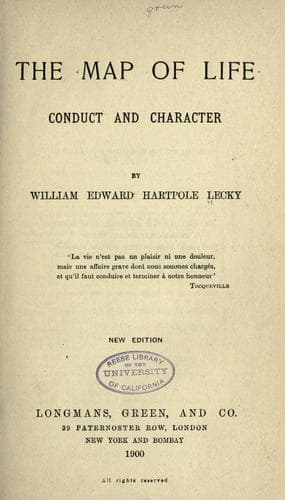
The Map of Life: Conduct and CharacterLecky, William Edward Hartpole
Philosophy
The Map of Life: Conduct and Character
Lecky, William Edward Hartpole
Character; Conduct of life
A large and difficult field of moral compromise is opened out in the
case of war, which necessarily involves a complete suspension of great
portions of the moral law. This is not merely the case in unjust wars;
it applies also, though in a less degree, to those which are most
necessary and most righteous. War is not, and never can be, a mere
passionless discharge of a painful duty. It is in its essence, and it is
a main condition of its success, to kindle into fierce exercise among
great masses of men the destructive and combative passions--passions as
fierce and as malevolent as that with which the hound hunts the fox to
its death or the tiger springs upon its prey. Destruction is one of its
chief ends. Deception is one of its chief means, and one of the great
arts of skilful generalship is to deceive in order to destroy. Whatever
other elements may mingle with and dignify war, this at least is never
absent; and however reluctantly men may enter into war, however
conscientiously they may endeavour to avoid it, they must know that when
the scene of carnage has once opened these things must be not only
accepted and condoned, but stimulated, encouraged and applauded. It
would be difficult to conceive a disposition more remote from the morals
of ordinary life, not to speak of Christian ideals, than that with which
the soldiers most animated with the fire and passion that lead to
victory rush forward to bayonet the foe.
War indeed, which is absolutely indispensable in our present stage of
civilisation, has its own morals which are very different from those of
peaceful life. Yet there are few fields in which, through the stress of
moral motives, greater changes have been effected. In the early stages
of human history it was simply a question of power. There was no
distinction between piracy and regular war, and incursions into a
neighbouring State without provocation and with the sole purpose of
plunder brought with them no moral blame. To carry the inhabitants of a
conquered country into slavery; to slaughter the whole population of a
besieged town; to destroy over vast tracts every town, village and
house, and to put to death every prisoner, were among the ordinary
incidents of war. These things were done without reproach in the best
periods of Greek and Roman civilisation. In many cases neither age nor
sex was spared![25] In Rome the conquered general was strangled or
starved to death in the Mamertine prison. Tens of thousands of captives
were condemned to perish in gladiatorial shows. Julius Cæsar, whose
clemency has been so greatly extolled, 'executed the whole senate of the
Veneti; permitted a massacre of the Usipetes and Tencteri; sold as
slaves 40,000 natives of Genabum; and cut off the right hands of all the
brave men whose only crime was that they held to the last against him
their town of Uxellodunum.'[26] No slaughter in history is more terrible
than that which took place at Jerusalem under the general who was
Public-domain text, read in full here on John Shaqi.
Reviews
Reviews
No reviews yet
Be the first to share your thoughts on this work.
Elsewhere in the archive
Join the Discussion
Join the discussion
Sign in to leave a comment or review.
Sign InorCreate an account