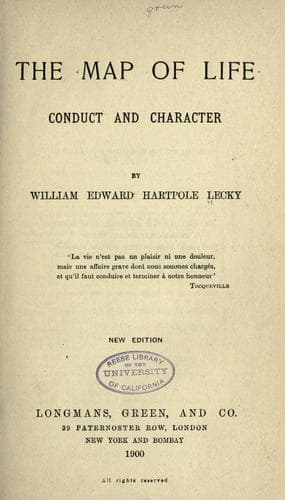
The Map of Life: Conduct and CharacterLecky, William Edward Hartpole
Philosophy
The Map of Life: Conduct and Character
Lecky, William Edward Hartpole
Character; Conduct of life
The treatment of prisoners has been profoundly modified. Quarter, it is
true, has been very often refused in modern wars to rebels, to soldiers
in mutiny, to revolted slaves, to savages who themselves give no
quarter. It has been often--perhaps generally--refused to irregular
soldiers like the French Francs-tireurs in the War of 1870, who without
uniforms endeavoured to defend their homes against invasion. It was long
refused to soldiers who, having rejected terms of surrender, continued
to defend an indefensible place, but this severity during the last three
centuries has been generally condemned. But, on the whole, the treatment
of the conquered soldier has steadily improved. At one time he was
killed. At another he was preserved as a slave. Then he was permitted to
free himself by payment of a ransom; now he is simply kept in custody
till he is exchanged or released on parole, or till the termination of
the war. In the latter half of the present century many elaborate and
beneficent regulations for the preservation of hospitals and the good
treatment of the wounded have been sanctioned by international
agreement. The distinction between the civil population and combatants
has been increasingly observed. As a general rule non-combatants, if
they do not obstruct the enemy, are subjected to no further injury than
that of paying war contributions and in other ways providing for the
subsistence of the invaders. The wanton destruction of private property
has been more and more avoided. Such an act as the devastation of the
Palatinate under Louis XIV. would now in a European war be universally
condemned, though the wholesale destruction of villages in our own
Indian frontier wars and the methods employed on both sides in the civil
war in Cuba appear to have borne much resemblance to it. In the
treatment of merchants the rule of reciprocity which was laid down in
Magna Charta is largely observed, and the Conference of Brussels in 1874
pronounced it to be contrary to the laws of war to bombard an
unfortified town. The great Civil War in America probably contributed
not a little to raise the standard of humanity in war; for while few
long wars have been fought with such determination or at the cost of so
many lives, very few have been conducted with such a scrupulous
abstinence from acts of wanton barbarity.
Public-domain text, read in full here on John Shaqi.
Reviews
Reviews
No reviews yet
Be the first to share your thoughts on this work.
Elsewhere in the archive
Join the Discussion
Join the discussion
Sign in to leave a comment or review.
Sign InorCreate an account