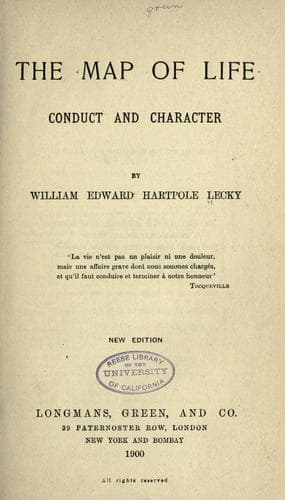
The Map of Life: Conduct and CharacterLecky, William Edward Hartpole
Philosophy
The Map of Life: Conduct and Character
Lecky, William Edward Hartpole
Character; Conduct of life
called 'the delight of the human race,' and when the last spasm of
resistance had ceased, Titus sent Jewish captives, both male and female,
by thousands to the provincial amphitheatres to be devoured by wild
beasts or slaughtered as gladiators.
Yet from a very early period lines were drawn forming a clear though
somewhat arbitrary code of military morals. In Greece a broad
distinction was made between wars with Greek States and with Barbarians,
the latter being regarded as almost outside the pale of moral
consideration. It is a distinction which in reality was not very widely
different from that which Christian nations have in practice continually
made between wars within the borders of Christendom, and wars with
savage or pagan nations. Greek, and perhaps still more Roman, moralists
have written much on the just causes of war. Many of them condemn all
unjust, aggressive, or even unnecessary wars. Some of them insist on the
duty of States always endeavouring by conferences, or even by
arbitration, to avert war, and although these precepts, like the
corresponding precepts of Christian divines, were often violated, they
were certainly not without some influence on affairs. It is probably not
too much to say that in this respect Roman wars do not compare
unfavourably with those of Christian periods. It is remarkable how large
a part of the best Christian works on the ethics of war is based on the
precepts of pagan moralists, and although in antiquity as in modern
times the real cause of war was often very different from the pretexts,
the sense of justice in war was as clearly marked in Roman as in most
Christian periods.[27]
Great stress was laid upon the duty of a formal declaration of war
preceding hostilities. Polybius mentions the reprobation that was
attached in Greece to the Ætolians for having neglected this custom. It
was universal in Roman times, and during the mediæval period the custom
of sending a challenge to the hostile power was carefully observed. In
modern times formal declaration of war has fallen greatly into
desuetude. The hostilities between England and Spain under Elizabeth,
and the invasion of Germany by Gustavus Adolphus, were begun without any
such declaration, and there have been numerous instances in later
times.[28]
Public-domain text, read in full here on John Shaqi.
Reviews
Reviews
No reviews yet
Be the first to share your thoughts on this work.
Elsewhere in the archive
Join the Discussion
Join the discussion
Sign in to leave a comment or review.
Sign InorCreate an account