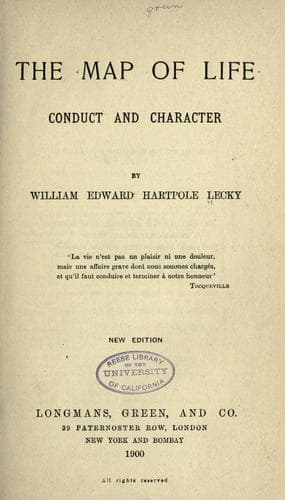
The Map of Life: Conduct and CharacterLecky, William Edward Hartpole
Philosophy
The Map of Life: Conduct and Character
Lecky, William Edward Hartpole
Character; Conduct of life
Apart from the questions I have discussed there is another class of
questions connected with war which present great difficulty. It is the
right of men to abdicate their private judgment by entering into the
military profession. In small nations this question is not of much
importance, for in them wars are of very rare occurrence and are usually
for self-defence. In a great empire it is wholly different. Hardly any
one will be so confident of the virtue of his rulers as to believe that
every war which his country wages in every part of its dominions, with
uncivilised as well as civilised populations, is just and necessary, and
it is certainly _primâ facie_ not in accordance with an ideal morality
that men should bind themselves absolutely for life or for a term of
years to kill without question, at the command of their superiors, those
who have personally done them no wrong. Yet this unquestioning obedience
is the very essence of military discipline, and without it the
efficiency of armies and the safety of nations would be hopelessly
destroyed. It is necessary to the great interests of society, and
therefore it is maintained, strengthened by the obligation of an oath
and still more efficaciously by a code of honour which is one of the
strongest binding influences by which men can be governed.
It is not, however, altogether absolute, and a variety of distinctions
and compromises have been made. There is a difference between the man
who enlists in the army of his own country and a man who enlists in
foreign service either permanently or for the duration of a single war.
If a man unnecessarily takes an active part in a struggle between two
countries other than his own, it may at least be demanded that he should
be actuated, not by a mere spirit of adventure or personal ambition, but
by a strong and reasoned conviction that the cause which he is
supporting is a righteous one. The conduct of a man who enlists in a
foreign army which may possibly be used against his own country, and who
at least binds himself to obey absolutely chiefs who have no natural
authority over him, has been much condemned, but even here special
circumstances must be taken into account. Few persons I suppose would
seriously blame the Irish Catholics of the eighteenth century who filled
the armies of France, Austria, Spain and Naples at a time when
disqualifying laws excluded them, on account of their religion, from the
British army and from almost every path of ambition at home. There is
also perhaps some distinction between the position of a soldier who is
obliged to serve, and a soldier in a country where enlisting is
voluntary, and also between the position of an officer who can throw up
his commission without infringing the law, and a private who cannot
abandon his flag without committing a grave legal offence. At the
beginning of the war of the American Revolution some English officers
left the army rather than serve in a cause which they believed to be
unrighteous.
Public-domain text, read in full here on John Shaqi.
Reviews
Reviews
No reviews yet
Be the first to share your thoughts on this work.
Elsewhere in the archive
Join the Discussion
Join the discussion
Sign in to leave a comment or review.
Sign InorCreate an account