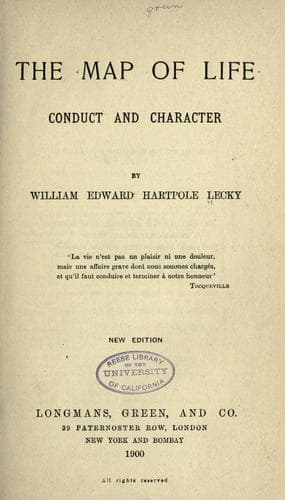
The Map of Life: Conduct and CharacterLecky, William Edward Hartpole
Philosophy
The Map of Life: Conduct and Character
Lecky, William Edward Hartpole
Character; Conduct of life
It was in their full power to do so, but probably none of
them would have desired that private soldiers who had no legal choice in
the matter should have followed their example and become deserters from
the ranks.
There are, however, extreme cases in which the violation of the military
oath and disobedience to military discipline are justified. More than
once in French history an usurper or his agent has ordered soldiers to
coerce or fire upon the representatives of the nation. In such cases it
has been said 'the conscience of the soldier is the liberty of the
people,' and the refusal of private soldiers to obey a plainly illegal
order will be generally though not universally applauded. In all such
cases, however, there is much obscurity and inconsistency of judgment.
The rule that the moral responsibility falls exclusively on the person
who gives the order, and that the private has no voice or
responsibility, will even here be maintained by some. Ought a private
soldier to have refused to take part in such an execution as that of the
Duc d'Enghien, or in the _Coup d'État_ of Napoleon III.? Ought he to
refuse to fire on a mob if he doubts the legality of the order of his
superior officer? In such cases there is sometimes a direct conflict
between the civil and the military law, and there have been instances in
which a soldier might be punishable before the first for acts which were
absolutely enforced by the second.[30]
Perhaps the strongest case of justifiable disobedience that can be
alleged is when a soldier is ordered to do something which involves
apostasy from his faith, though even here it would be difficult to show,
in the light of pure reason, that this is a graver thing than to kill
innocent men in an unrighteous cause. In the Early Church there were
some soldier martyrs who suffered death because they believed it
inconsistent with their faith to bear arms, or because they were asked
to do some acts which savoured of idolatry. The story of the Thebæan
legion which was said to have been martyred under Diocletian rests on no
trustworthy authority, but it illustrates the feeling of the Church on
the subject. Josephus tells how Jewish soldiers refused in spite of all
punishments to bring earth with the other soldiers for the reparation of
the Temple of Belus at Babylon. Conflicts between military duty and
religious duty must have not unfrequently arisen during the religious
wars of the sixteenth century, and in our own century and in our own
army there have been instances of soldiers refusing through religious
motives to escort or protect idolatrous processions in India, or to
present arms in Catholic countries when the Host was passing. Quaker
opinions about war are absolutely inconsistent with the compulsory
service which prevails in nearly all European countries, and religious
scruples about conscription have been among the motives that have
brought the Russian Raskolniks into collision with the civil power.
Public-domain text, read in full here on John Shaqi.
Reviews
Reviews
No reviews yet
Be the first to share your thoughts on this work.
Elsewhere in the archive
Join the Discussion
Join the discussion
Sign in to leave a comment or review.
Sign InorCreate an account