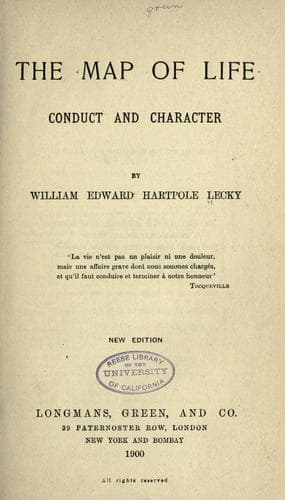
The Map of Life: Conduct and CharacterLecky, William Edward Hartpole
Philosophy
The Map of Life: Conduct and Character
Lecky, William Edward Hartpole
Character; Conduct of life
One of the most serious instances of the collision of duties in our time
is furnished by the great Sepoy Mutiny of 1857. From the days of Clive,
Sepoy soldiers have served under the British flag with an admirable
fidelity, and the Mutiny of Vellore in 1806, which was the one
exception, was due, like that of 1857, to a belief that the British
Government were interfering with their faith. Few things in the history
of the great Mutiny are so touching as the profound belief of the
English commanders of the Sepoy regiments in the unalterable loyalty of
their soldiers. Many of them lost their lives through this belief,
refusing even to the last moment and in spite of all evidence to abandon
it. They were deceived, and, in the fierce outburst of indignation that
followed, the conduct of the Sepoy soldiers was branded as the blackest
and the most unprovoked treachery.
Yet assuredly no charge was less true. Agitators for their own selfish
purposes had indeed acted upon the troops, but recent researches have
fully proved that the real as well as the ostensible cause of the Mutiny
was the greased cartridges. It was believed that the cartridges which
had been recently issued for the Sepoy regiments were smeared with a
mixture of cow's fat and pig's fat, one of these ingredients being
utterly impure in the eyes of the Hindoo, and the other in the eyes of
the Mussulman. To bite these cartridges would destroy the caste of the
Hindoo and carry with it the loss of everything that was most dear and
most sacred to him both in this world and in the next. In the eyes both
of the Moslem and the Hindoo it was the gravest and the most irreparable
of crimes, destroying all hopes in a future world, and yet this crime,
in their belief, was imposed upon them as a matter of military duty by
their officers. It was as if the Puritan soldiers of the seventeenth
century had been ordered by their commanders to abjure their hopes of
salvation and to repudiate and insult the Christian faith.
It is true that the existence of these obnoxious ingredients in the new
cartridges was solemnly denied, but the sincerity of the Sepoy belief is
incontestable, and General Anson, the commander-in-chief, having
examined the cartridges, was compelled to admit that it was very
plausible.[31] 'I am not so much surprised,' he wrote to Lord Canning,
'at their objections to the cartridges, having seen them. I had no idea
they contained, or rather are smeared with such a quantity of grease,
which looks exactly like fat. After ramming down the ball, the muzzle of
the musket is covered with it.'
Public-domain text, read in full here on John Shaqi.
Reviews
Reviews
No reviews yet
Be the first to share your thoughts on this work.
Elsewhere in the archive
Join the Discussion
Join the discussion
Sign in to leave a comment or review.
Sign InorCreate an account