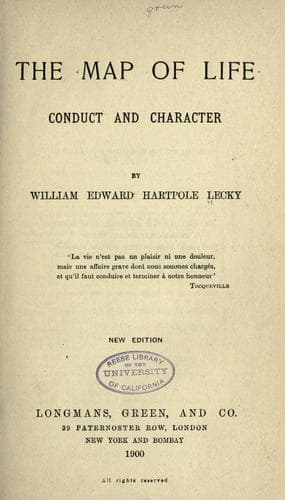
The Map of Life: Conduct and CharacterLecky, William Edward Hartpole
Philosophy
The Map of Life: Conduct and Character
Lecky, William Edward Hartpole
Character; Conduct of life
Johnson, in reply to some objections of Boswell, argues at length, but,
I think, with some sophistry, in favour of the profession. 'You are
not,' he says, 'to deceive your client with false representations of
your opinion. You are not to tell lies to the judge, but you need have
no scruple about taking up a case which you believe to be bad, or
affecting a warmth which you do not feel. You do not know your cause to
be bad till the judge determines it.... An argument which does not
convince yourself may convince the judge, and, if it does convince him,
you are wrong and he is right.... Everybody knows you are paid for
affecting warmth for your client, and it is therefore properly no
dissimulation.' Basil Montagu, in an excellent treatise on the subject,
urges that an advocate is simply an officer assisting in the
administration of justice under the impression that truth is best
elicited, and that difficulties are most effectually disentangled, by
the opposite statements of able men. He is an indispensable part of a
machine which in its net result is acting in the real interests of
truth, although he 'may profess feelings which he does not feel and may
support a cause which he knows to be wrong,' and although his advocacy
is 'a species of acting without an avowal that it is acting.'
It is, of course, possible to adopt the principles of the Quaker and to
condemn as unchristian all participation in the law courts, and although
the Catholic Church has never adopted this extreme, it seems to have
instinctively recognised some incompatibility between the profession of
an advocate and the saintly character. Renan notices the significant
fact that St. Yves, a saint of Brittany, appears to be the only advocate
who has found a place in its hagiology, and the worshippers were
accustomed to sing on his festival 'Advocatus et non latro--Res miranda
populo.' It is indeed evident that a good deal of moral compromise must
enter into this field, and the standards of right and wrong that have
been adopted have varied greatly. How far, for example, may a lawyer
support a cause which he believes to be wrong? In some ancient
legislations advocates were compelled to swear that they would not
defend causes which they thought or discovered to be unjust.[35] St.
Thomas Aquinas has laid down in emphatic terms that any lawyer who
undertakes the defence of an unjust cause is committing a grievous sin.
It is unlawful, he contends, to co-operate with any one who is doing
wrong, and an advocate clearly counsels and assists him whose cause he
undertakes. Modern Catholic casuists have dealt with the subject in the
same spirit. They admit, indeed, that an advocate may undertake the
defence of a criminal whom he knows to be guilty, in order to bring to
light all extenuating circumstances, but they contend that no advocate
should undertake a civil cause unless by a previous and careful
examination he has convinced himself that it is a just one; that no
Public-domain text, read in full here on John Shaqi.
Reviews
Reviews
No reviews yet
Be the first to share your thoughts on this work.
Elsewhere in the archive
Join the Discussion
Join the discussion
Sign in to leave a comment or review.
Sign InorCreate an account