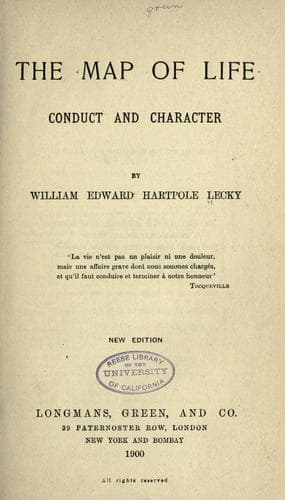
The Map of Life: Conduct and CharacterLecky, William Edward Hartpole
Philosophy
The Map of Life: Conduct and Character
Lecky, William Edward Hartpole
Character; Conduct of life
advocate can without sin undertake a cause which he knows or strongly
believes to be unjust; that if he has done so he is himself bound in
conscience to make restitution to the party that has been injured by his
advocacy; that if in the course of a trial he discovers that a cause
which he had believed to be just is unjust he must try to persuade his
client to desist, and if he fails in this must himself abandon the
cause, though without informing the opposite party of the conclusion at
which he had arrived; that in conducting his case he must abstain from
wounding the reputation of his neighbour or endeavouring to influence
the judges by bringing before them misdeeds of his opponent which are
not connected with and are not essential to the case.[36] As lately as
1886 an order was issued from Rome, with the express approbation of the
Pope, forbidding any Catholic, mayor or judge, to take part in a
divorce case, as divorce is absolutely condemned by the Church.[37]
There have been, and perhaps still are, instances of lawyers
endeavouring to limit their practice to cases which they believed to be
just. Sir Matthew Hale is a conspicuous example, but he acknowledged
that he considerably relaxed his rule on the subject, having found in
two instances that cases which at the first blush seemed very worthless
were in truth well founded. As a general rule English lawyers make no
discrimination on this ground in accepting briefs unless the injustice
is very flagrant, nor will they, except in very extreme cases, do their
client the great injury of throwing up a brief which they have once
accepted. They contend that by acting in this way the administration of
justice in the long run is best served, and in this fact they find its
justification.
In the conduct of a case there are rules analogous to those which
distinguish between honourable and dishonourable war, but they are less
clearly defined and less universally accepted. In criminal prosecutions
a remarkable though very explicable distinction is drawn between the
prosecutor and the defender. It is the etiquette of the profession that
the former is bound to aim only at truth, neither straining any point
against the prisoner nor keeping back any fact which is favourable to
him, nor using any argument which he does not himself believe to be
just. The defender, however, is not bound, according to professional
etiquette, by such rules. He may use arguments which he knows to be
bad, conceal or shut out by technical objections facts that will tell
against his clients, and, subject to some wide and vague restrictions,
he must make the acquittal of his client his first object.[38]
Public-domain text, read in full here on John Shaqi.
Reviews
Reviews
No reviews yet
Be the first to share your thoughts on this work.
Elsewhere in the archive
Join the Discussion
Join the discussion
Sign in to leave a comment or review.
Sign InorCreate an account