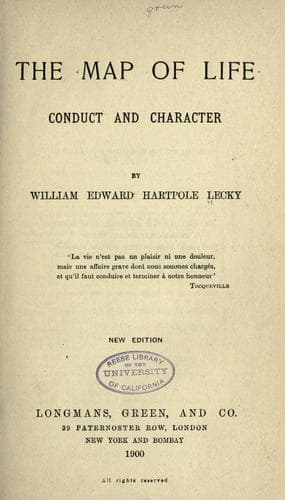
The Map of Life: Conduct and CharacterLecky, William Edward Hartpole
Philosophy
The Map of Life: Conduct and Character
Lecky, William Edward Hartpole
Character; Conduct of life
The great legal reforms of the past half-century have removed most of
these abuses, and have at the same time introduced a wider and juster
spirit into the practical administration of the law. Yet even now
different judges sometimes differ widely in the importance they attach
to substantial justice and to legal technicalities; and even now one of
the advantages of trial by jury is that it brings the masculine common
sense and the unsophisticated sense of justice of unprofessional men
into fields that would otherwise be often distorted by ingenious
subtleties. It is, however, far less in the position of the judge than
in the position of an advocate that the most difficult moral questions
of the legal profession arise. The difference between an unscrupulous
advocate and an advocate who is governed by a high sense of honour and
morality is very manifest, but at best there must be many things in the
profession from which a very sensitive conscience would recoil, and
things must be said and done which can hardly be justified except on the
ground that the existence of this profession and the prescribed methods
of its action are in the long run indispensable to the honest
administration of justice.
The same method of reasoning applies to other great departments of
life. In politics it is especially needed. In free countries party
government is the best if not the only way of conducting public affairs,
but it is impossible to conduct it without a large amount of moral
compromise; without a frequent surrender of private judgment and will. A
good man will choose his party through disinterested motives, and with a
firm and honest conviction that it represents the cast of policy most
beneficial to the country. He will on grave occasions assert his
independence of party, but in the large majority of cases he must act
with his party even if they are pursuing courses in some degree contrary
to his own judgment.
Public-domain text, read in full here on John Shaqi.
Reviews
Reviews
No reviews yet
Be the first to share your thoughts on this work.
Elsewhere in the archive
Join the Discussion
Join the discussion
Sign in to leave a comment or review.
Sign InorCreate an account