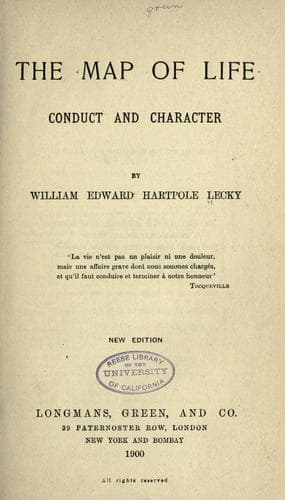
The Map of Life: Conduct and CharacterLecky, William Edward Hartpole
Philosophy
The Map of Life: Conduct and Character
Lecky, William Edward Hartpole
Character; Conduct of life
Every one who is actively engaged in politics--every one especially who
is a member of the House of Commons--must soon learn that if the
absolute independence of individual judgment were pushed to its extreme,
political anarchy would ensue. The complete concurrence of a large
number of independent judgments in a complicated measure is impossible.
If party government is to be carried on, there must be, both in the
Cabinet and in Parliament, perpetual compromise. The first condition of
its success is that the Government should have a stable, permanent,
disciplined support behind it, and in order that this should be attained
the individual member must in most cases vote with his party. Sometimes
he must support a measure which he knows to be bad, because its
rejection would involve a change of government which he believes would
be a still greater evil than its acceptance, and in order to prevent
this evil he may have to vote a direct negative to some resolution
containing a statement which he believes to be true. At the same time,
if he is an honest man, he will not be a mere slave of party. Sometimes
a question arises which he considers so supremely important that he will
break away from his party and endeavour at all hazards to carry or to
defeat it. Much more frequently he will either abstain from voting, or
will vote against the Government on a particular question, but only when
he knows that by taking this course he is simply making a protest which
will produce no serious political complication. On most great measures
there is a dissentient minority in the Government party, and it often
exercises a most useful influence in representing independent opinion,
and bringing into the measure modifications and compromises which allay
opposition, gratify minorities, and soften differences. But the action
of that party will be governed by many motives other than a simple
consideration of the merits of the case. It is not sufficient to say
that they must vote for every resolution which they believe to be true,
for every bill or clause of a bill which they believe to be right, and
must vote against every bill or clause or resolution about which they
form an opposite judgment. Sometimes they will try in private to prevent
the introduction of a measure, but when it is introduced they will feel
it their duty either positively to support it or at least to abstain
from protesting against it. Sometimes they will either vote against it
or abstain from voting at all, but only when the majority is so large
that it is sure to be carried. Sometimes their conduct will be the
result of a bargain--they will vote for one portion of a bill of which
they disapprove because they have obtained from the Government a
concession on another which they think more important. The nature of
their opposition will depend largely upon the strength or weakness of
the Government, upon the size of the majority, upon the degree in which
Public-domain text, read in full here on John Shaqi.
Reviews
Reviews
No reviews yet
Be the first to share your thoughts on this work.
Elsewhere in the archive
Join the Discussion
Join the discussion
Sign in to leave a comment or review.
Sign InorCreate an account