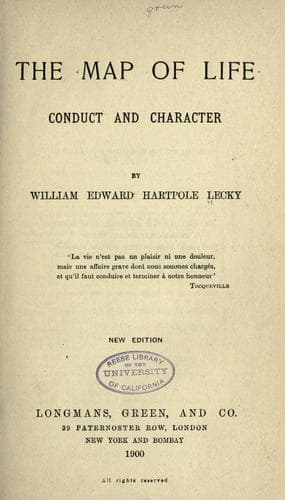
The Map of Life: Conduct and CharacterLecky, William Edward Hartpole
Philosophy
The Map of Life: Conduct and Character
Lecky, William Edward Hartpole
Character; Conduct of life
Other questions of a somewhat different nature, but involving grave
moral considerations, arise out of the relations between a member and
his constituents. In the days when small boroughs were openly bought in
the market, this was sometimes defended on the ground of the complete
independence of judgment which it gave to the purchasing member. Romilly
and Henry Flood are said to have both purchased their seats with the
express object of securing such independence. In the political
philosophy of Burke, no doctrine is more emphatically enforced than that
a member of Parliament is a representative but not a delegate; that he
owes to his constituents not only his time and his services, but also
the exercise of his independent and unfettered judgment; that, while
reflecting the general cast of their politics, he must never suffer
himself to be reduced to a mere mouthpiece, or accept binding
instructions prescribing on each particular measure the course he may
pursue; that after his election he must consider himself a member of an
Imperial Parliament rather than the representative of a particular
locality, and must subordinate local and special interests to the wider
and more general interests of the whole nation.
The conditions of modern political life have greatly narrowed this
liberty of judgment. In most constituencies a member can only enter
Parliament fettered by many pledges relating to specific measures, and
in every turn of policy sections of his constituents will attempt to
dictate his course of action. Certain large and general pledges
naturally and properly precede his election. He is chosen as a supporter
or opponent of the Government; he avows himself an adherent of certain
broad lines of policy, and he also represents in a special degree the
interests and the distinctive type of opinion of the class or industry
which is dominant in his constituency. But even at the time of election
he often finds that on some particular question in which his electors
are much interested he differs from them, though they consent, in spite
of it, to elect him; and, in the course of a long Parliament, others are
very apt unexpectedly to arise. Political changes take place which bring
into the foreground matters which at the time of the election seemed
very remote, or produce new questions, or give rise to unforeseen party
combinations, developments, and tendencies. It will often happen that on
these occasions a member will think differently from the majority of his
electors, and he must meet the question how far he must sacrifice his
judgment to theirs, and how far he may use the influence which their
votes have given him to act in opposition to their wishes and perhaps
even to their interests. Burke, for example, found himself in this
position when, being member for Bristol, he considered it his duty to
support the concession of Free-trade to Ireland, although his
constituents had, or thought they had, a strong interest in commercial
Public-domain text, read in full here on John Shaqi.
Reviews
Reviews
No reviews yet
Be the first to share your thoughts on this work.
Elsewhere in the archive
Join the Discussion
Join the discussion
Sign in to leave a comment or review.
Sign InorCreate an account