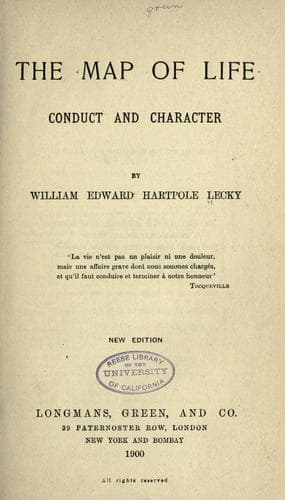
The Map of Life: Conduct and CharacterLecky, William Edward Hartpole
Philosophy
The Map of Life: Conduct and Character
Lecky, William Edward Hartpole
Character; Conduct of life
restrictions and monopoly. In our own day it has happened that members
representing manufacturing districts of Lancashire have found themselves
unexpectedly called upon to vote upon some measure for crippling or
extending rival manufactures in India; for opening new markets by some
very dubious aggression in a distant land; or for limiting the child
labour employed in the local manufacture; and these members have often
believed that the right course was a course which was exceedingly
repugnant to great sections of their electors.
Sometimes, too, a member is elected on purely secular issues, but in the
course of the Parliament one of those fierce, sudden storms of religious
sentiment, to which England is occasionally liable, sweeps over the
land, and he finds himself wholly out of sympathy with a great portion
of his constituency. In other cases the party which he entered
Parliament to support, pursues, on some grave question, a line of policy
which he believes to be seriously wrong, and he goes into partial or
even complete and bitter opposition. Differences of this kind have
frequently arisen when there is no question of any interested motive
having influenced the member. Sometimes in such cases he has resigned
his seat and gone to his electors for re-election. In other cases he
remains in Parliament till the next election. Each case, however, must
be left to individual judgment, and no clear, definite, unwavering moral
line can be drawn. The member will consider the magnitude of the
disputed question, both in his own eyes and in the eyes of those whom he
represents; its permanent or transitory character, the amount and
importance of the majority opposed to his views, the length of time that
is likely to elapse before a dissolution will bring him face to face
with his constituents. In matters which he does not consider very urgent
or important, he will probably sacrifice his own judgment to that of his
electors, at least so far as to abstain from voting or from pressing his
own views. In graver matters it is his duty boldly to face unpopularity,
or perhaps even take the extreme step of resigning his seat.
Public-domain text, read in full here on John Shaqi.
Reviews
Reviews
No reviews yet
Be the first to share your thoughts on this work.
Elsewhere in the archive
Join the Discussion
Join the discussion
Sign in to leave a comment or review.
Sign InorCreate an account