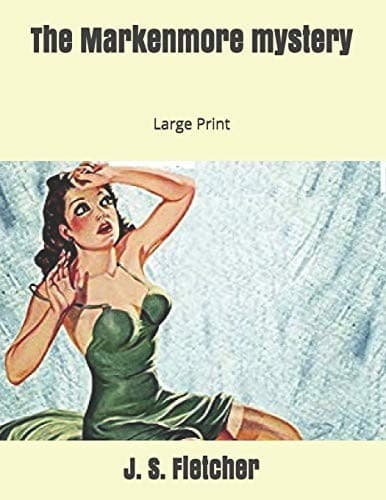
The Markenmore MysteryFletcher, J. S. (Joseph Smith)
General
The Markenmore Mystery
Fletcher, J. S. (Joseph Smith)
Detective and mystery stories; Murder -- Investigation -- Fiction
“Something very wrong, sir,” replied the policeman. He drew nearer,
and turning, pointed to the shrouded figure. “Gentleman lying there
dead, sir. Shot through the head!—but whether its murder or suicide,
I can’t say, sir. Murder I think—anyhow, there’s no revolver lying
near. And it’s been a revolver.”
“Good heavens!” exclaimed Mr. Fransemmery. “Why—who was he?”
The policeman gave him a sharp look.
“I couldn’t have said, sir,” he replied. “I’ve only been here three
years, so of course I don’t know him. But these other two men, they
do: Mr. Guy Markenmore, sir.”
Mr. Fransemmery started.
“What!” he exclaimed. “Sir Anthony’s elder son? You don’t mean it.”
“They say so, sir, and they know him well enough,” answered the
policeman. “That man, Hobbs, the ploughman, found him. He ran down to
the keeper’s cottage, and to me, and we came up at once. But before
coming I telephoned to Selcaster, and the Chief Constable himself is
coming along—they said he was starting out then, with the doctor.
Come and look at him, sir.”
Mr. Fransemmery nerved himself to this sad task, and went nearer. The
keeper and the labourer touched their caps; the policeman drew aside
the cloak which the labourer had taken from his shoulders and laid
over the dead man. And Mr. Fransemmery, wondering what all this
meant, bent down.
Dead enough, he thought. And peaceful enough. A calm, bloodless face,
neither smile nor frown on it—nothing but a little drawing together
of the finely marked eyebrows, a slightly puzzled expression.
Otherwise, so still. . . .
“It must have been murder, sir,” whispered the policeman, “and at
close quarters. Look there!—the skin over his temples slightly
burnt. And——”
“They’re coming,” said the keeper suddenly. “Two or three of them.”
Mr. Fransemmery straightened himself and looked across the downs. A
dog-cart, driven at considerable speed, was coming along the
grass-track from the direction of Selcaster, the tall spire of whose
cathedral showed above the woods which lay between the downs and the
old city. In the gleam of the rapidly rising sun he caught the glint
of the silver and blue uniform of the county police, and as the
keeper had said, the dog-cart, driven by a policeman, seemed filled
with men. And presently it raced up the sward to the lip of the
hollow, and the Chief Constable, a military-looking man of middle
age, jumped out and followed by two other men, one the
police-surgeon, the other obviously a plain-clothes officer, came
hurrying down to the little group beneath the Scotch firs. He nodded
to Mr. Fransemmery, whom everybody in the district knew, and turned
sharply on the village constable.
“Who found this man?” he asked quickly.
The ploughman came forward, with evident distaste.
“I did, sir!” he answered. “James Hobbs—work at Mr. Marrow’s.”
“When—and how?” asked the Chief Constable.
Public-domain text, read in full here on John Shaqi.
Reviews
Reviews
No reviews yet
Be the first to share your thoughts on this work.
Join the Discussion
Join the discussion
Sign in to leave a comment or review.
Sign InorCreate an account