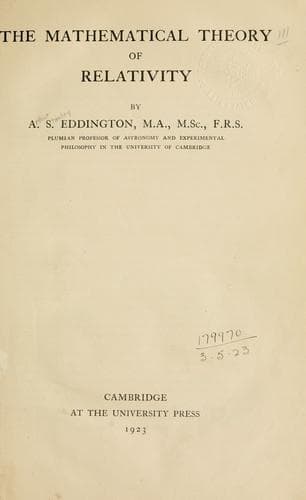
The Mathematical Theory of RelativityEddington, Arthur Stanley, Sir
Science
The Mathematical Theory of Relativity
Eddington, Arthur Stanley, Sir
Relativity (Physics)
It is not possible to make the second derivatives of the~$g_{\mu\nu}$ vanish at the
selected point (as well as the first derivatives) unless the Riemann-Christoffel
tensor vanishes there; but a great number of other special conditions can be
imposed on the $100$~second derivatives by choosing the coordinates suitably.
Make an additional transformation of the form
\[
x_{\epsilon} = g_{\mu}^{\epsilon} x_{\mu}' + \tfrac{1}{6} a_{\mu\nu\sigma}^{\epsilon}\, x_{\mu}' x_{\nu}' x_{\sigma}',
\Tag{(36.5)}
\]
where $a_{\mu\nu\sigma}^{\epsilon}$~represents arbitrary coefficients symmetrical in $\mu$,~$\nu$,~$\rho$. This new
transformation will not affect the first derivatives of the~$g_{\mu\nu}$ at the origin,
which have already been made to vanish by the previous transformation, but
it alters the second derivatives. By differentiating~\Eq{(31.3)}, viz.\
\[
\{\mu\nu, \rho\}'\, \frac{\dd x_{\epsilon}}{\dd x_{\rho}'}
- \frac{\dd x_{\alpha}}{\dd x_{\mu}'}\, \frac{\dd x_{\beta}}{\dd x_{\nu}'}\, \{\alpha\beta, \epsilon\}
= \frac{\dd^{2} x_{\epsilon}}{\dd x_{\mu}'\, \dd x_{\nu}'},
\]
we obtain at the origin
\[
\frac{\dd}{\dd x_{\sigma}'}\{\mu\nu, \rho\}'\, \frac{\dd x_{\epsilon}}{\dd x_{\rho}'}
- \frac{\dd x_{\alpha}}{\dd x_{\mu}'}\,
\frac{\dd x_{\beta}}{\dd x_{\nu}'}\,
\frac{\dd x_{\gamma}}{\dd x_{\sigma}'}\,
\frac{\dd}{\dd x_{\gamma}} \{\alpha\beta, \epsilon\}
= \frac{\dd^{3} x_{\epsilon}}{\dd x_{\mu}'\, \dd x_{\nu}'\, \dd x_{\sigma}'},
\]
since the $3$-index symbols themselves vanish. Hence by~\Eq{(36.5)}\footnote
{For the disappearance of the factor~$\frac{1}{6}$, see~\Eq{(35.6)}.}
\[
\frac{\dd}{\dd x_{\sigma}'} \{\mu\nu, \rho\}' · g_{\rho}^{\epsilon}
- g_{\mu}^{\alpha} g_{\nu}^{\beta} g_{\sigma}^{\gamma}\, \frac{\dd}{\dd x_{\gamma}} \{\alpha\beta, \epsilon\}
= a_{\mu\nu\sigma}^{\epsilon},
\]
which reduces to
\[
\frac{\dd}{\dd x_{\sigma}'} \{\mu\nu, \epsilon\}'
- \frac{\dd}{\dd x_{\sigma}} \{\mu\nu, \epsilon\} = a_{\mu\nu\sigma}^{\epsilon}.
\Tag{(36.55)}
\]
The transformation~\Eq{(36.5)} accordingly increases $\dd \{\mu\nu, \epsilon\}/\dd x_{\sigma}$ by~$a_{\mu\nu\sigma}^{\epsilon}$.
Owing to the symmetry of~$a_{\mu\nu\sigma}^{\epsilon}$, all three quantities
\[
\frac{\dd}{\dd x_{\sigma}} \{\mu\nu, \epsilon\},\quad
\frac{\dd}{\dd x_{\nu}} \{\mu\sigma, \epsilon\},\quad
\frac{\dd}{\dd x_{\mu}} \{\nu\sigma, \epsilon\}
\]
\PageSep{79}
are necessarily increased by the same amount. Now the unaltered difference
\[
\frac{\dd}{\dd x_{\nu}} \{\mu\sigma, \epsilon\}
- \frac{\dd}{\dd x_{\sigma}} \{\mu\nu, \epsilon\}
= B_{\mu\nu\sigma}^{\epsilon},
\Tag{(36.6)}
\]
since the remaining terms of~\Eq{(34.4)} vanish in the coordinates here used. We
cannot alter any of the components of the Riemann-Christoffel tensor; but,
\index{Riemann-Christoffel tensor!importance of}%
subject to this limitation, the alterations of the derivatives of the $3$-index
symbols are arbitrary.
Public-domain text, read in full here on John Shaqi.
Reviews
Reviews
No reviews yet
Be the first to share your thoughts on this work.
Elsewhere in the archive
Join the Discussion
Join the discussion
Sign in to leave a comment or review.
Sign InorCreate an account