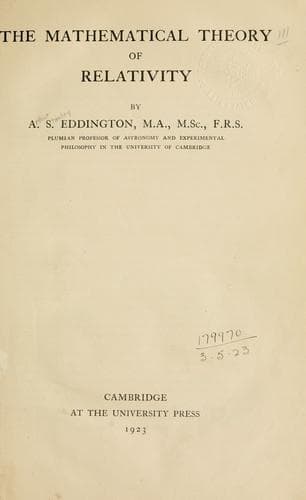
The Mathematical Theory of RelativityEddington, Arthur Stanley, Sir
Science
The Mathematical Theory of Relativity
Eddington, Arthur Stanley, Sir
Relativity (Physics)
For a circular orbit the Newtonian theory gives
\[
m = \omega^{2} r^{3} = v^{2} r,
\]
the constant of gravitation being unity. Applying this to the earth, $v = 30$ km.\
per~sec.\ $= 10^{-4}$ in terms of the velocity of light, and $r = 1.5 · 10^{8}$~km. Hence
the mass~$m$ of the sun is approximately $1.5$~kilometres. The mass of the earth
is $1/300,000$th of this, or about $5$~millimetres\footnotemark.\footnotetext
{Objection is sometimes taken to the use of a centimetre as a unit of gravitational (i.e.\
gravitation-exerting) mass; but the same objection would apply to the use of a gram, since the
gram is properly a measure of a different property of the particle, viz.\ its \emph{inertia}. Our constant
of integration~$m$ is clearly a length and the reader may, if he wishes to make this clear, call it
the gravitational radius instead of the gravitational mass. But when it is realised that the gravitational
radius in centimetres, the inertia in grams, and the energy in ergs, are merely measure-numbers
in different codes of the \emph{same} intrinsic quality of the particle, it seems unduly pedantic
to insist on the older discrimination of these units which grew up on the assumption that they
measured qualities which were radically different.}
More accurately, the mass of the sun, $1.99 · 10^{33}$ grams, becomes in gravitational
\index{Gravitational mass of sun}%
\index{Sun, gravitational mass of}%
units $1.47$~kilometres; and other masses are converted in a like
proportion.
\PageSep{88}
\Section{40.}{The advance of perihelion}
\index{Perihelion!advance of}%
The equation \Eq{(39.5)} for the orbit of a planet can be integrated in terms
of elliptic functions; but we obtain the astronomical results more directly by
a method of successive approximation. We proceed from equation~\Eq{(39.61)}
\[
\frac{d^{2}u}{d\phi^{2}} + u = \frac{m}{h^{2}} + 3mu^{2}.
\Tag{(40.1)}
\]
Neglecting the small term~$3mu^{2}$, the solution is
\[
u = \frac{m}{h^{2}} \bigl(1 + e\cos(\phi - \varpi)\bigr),
\Tag{(40.2)}
\]
as in Newtonian dynamics. The constants of integration, $e$~and $\varpi$, are the
eccentricity and longitude of perihelion.
Public-domain text, read in full here on John Shaqi.
Reviews
Reviews
No reviews yet
Be the first to share your thoughts on this work.
Elsewhere in the archive
Join the Discussion
Join the discussion
Sign in to leave a comment or review.
Sign InorCreate an account