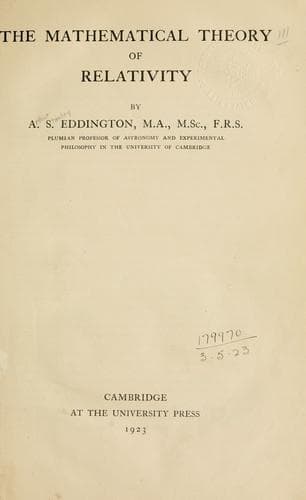
The Mathematical Theory of RelativityEddington, Arthur Stanley, Sir
Science
The Mathematical Theory of Relativity
Eddington, Arthur Stanley, Sir
Relativity (Physics)
In \Eq{(39.61)} the ratio of $3mu^{2}$ to~$m/h^{2}$ is $3h^{2}u^{2}$, or by \Eq{(39.62)}
\[
3\left(r\, \frac{d\phi}{ds}\right)^{2}.
\]
For ordinary speeds this is an extremely small quantity---practically three
times the square of the transverse velocity in terms of the velocity of light.
For example, this ratio for the earth is $\Add{0}.00000003$. In practical cases the extra
\PageSep{87}
term in~\Eq{(39.61)} will represent an almost inappreciable correction to the Newtonian
orbit~\Eq{(39.71)}.
Again in \Eq{(39.62)} and \Eq{(39.72)} the difference between $ds$ and~$dt$ is equally
insignificant, even if we were sure of what is meant by~$dt$ in the Newtonian
theory. The \emph{proper-time} for the body is~$ds$, and it might perhaps be urged
\index{Proper-time}%
that $dt$~in equation~\Eq{(39.72)} is intended to refer to this; but on the other hand
$s$~cannot be used as a coordinate since $ds$~is not a complete differential, and
Newton's ``time'' is always assumed to be a coordinate.
Thus it appears that a particle moving in the field here discussed will
behave as though it were under the influence of the Newtonian force exerted
by a particle of gravitational mass~$m$ at the origin, the motion agreeing with
the Newtonian theory to the order of accuracy for which that theory has been
confirmed by observation.
By showing that our solution satisfies $G_{\mu\nu} = 0$, we have proved that it
describes a possible state of the world which might be met with in nature
under suitable conditions. By deducing the orbit of a particle, we have discovered
how that state of the world would be recognised observationally if it
did exist. In this way we conclude that the space-time field represented by~\Eq{(38.8)}
is the one which accompanies (or ``is due to'') a particle of mass~$m$ at
the origin.
The gravitational mass~$m$ is the measure adopted in the Newtonian theory
of the power of the particle in causing a field of acceleration around it, the
units being here chosen so that the velocity of light and the constant of gravitation
are both unity. It should be noticed that we have as yet given no
reason to expect that $m$~in the present chapter has anything to do with the
$m$ introduced in \SecRef{12} to measure the inertial properties of the particle.
Public-domain text, read in full here on John Shaqi.
Reviews
Reviews
No reviews yet
Be the first to share your thoughts on this work.
Elsewhere in the archive
Join the Discussion
Join the discussion
Sign in to leave a comment or review.
Sign InorCreate an account