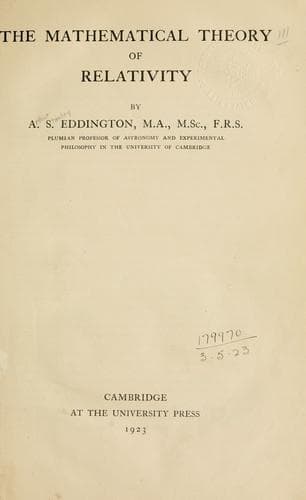
The Mathematical Theory of RelativityEddington, Arthur Stanley, Sir
Science
The Mathematical Theory of Relativity
Eddington, Arthur Stanley, Sir
Relativity (Physics)
The argument refers to \emph{similar} atoms and the question remains whether,
for example, a hydrogen atom on the sun is truly similar to a hydrogen atom
on the earth. Strictly speaking it cannot be exactly similar because it is in a
different kind of space-time, in which it would be impossible to make a finite
structure exactly similar to one existing in the space-time near the earth. But
if the interval of vibration of the hydrogen atom is modified by the kind of
space-time in which it lies, the difference must be dependent on some invariant
of the space-time. The simplest invariant which differs at the sun and the
earth is the square of the length of the Riemann-Christoffel tensor, viz.\
\[
B_{\mu\nu\sigma}^{\epsilon} B_{\epsilon}^{\mu\nu\sigma}.
\]
The value of this can be calculated from~\Eq{(38.8)} by the method used in that
section for calculating the~$G_{\mu\nu}$. The result is
\[
48\, \frac{m^{2}}{r^{6}}.
\]
\PageSep{93}
By consideration of dimensions it seems clear that the proportionate change
of~$ds$ would be of the order
\[
\frac{\sigma^{4} m^{2}}{r^{6}},
\]
where $\sigma$~is the radius of the atom; there does not seem to be any other length
concerned. For a comparison of solar and terrestrial atoms this would be about
$10^{-100}$. In any case it seems impossible to construct from the invariants of
space-time a term which would compensate the predicted shift of the spectral
lines, which is proportional to~$m/r$.
\Section{43.}{Isotropic coordinates}
\index{Coordinate-systems!isotropic}%
\index{Isotropic coordinates}%
We can transform the expression for the interval~\Eq{(38.8)} by making the
substitution
\[
r = \left(1 + \frac{m}{2r_{1}}\right)^{2} r_{1},
\Tag{(43.1)}
\]
so that
\begin{align*}
dr &= \left(1 - \frac{m^{2}}{4r_{1}^{2}}\right) dr_{1}, \\
\gamma &= \left(1 - \frac{m}{2r_{1}}\right)^{2}\bigg/\left(1 + \frac{m}{2r_{1}}\right)^{2}.
\end{align*}
Then \Eq{(38.8)}~becomes
\[
ds^{2} = -(1 + m/2r_{1})^{4} (dr_{1} + r_{1}^{2}\, d\theta^{2} + r_{1}^{2}\sin^{2}\theta\, d\phi^{2})
+ \frac{(1 - m/2r_{1})^{2}}{(1 + m/2r_{1})^{2}}\, dt^{2}.
\Tag{(43.2)}
\]
The coordinates $(r_{1},\theta, \phi)$ are called \emph{isotropic} polar coordinates. The corresponding
isotropic rectangular coordinates are obtained by putting
\[
x = r_{1} \sin\theta \cos\phi,\quad
y = r_{1} \sin\theta \sin\phi,\quad
z = r_{1} \cos\theta,
\]
giving
\[
ds^{2} = -(1 + m/2r_{1})^{4} (dx^{2} + dy^{2} + dz^{2})
+ \frac{(1 - m/2r_{1})^{2}}{(1 + m/2r_{1})^{2}}\, dt^{2},
\Tag{(43.3)}
\]
with
\[
r_{1} = \Chg{\surd(x^{2} + y^{2} + z^{2})}{\sqrt{x^{2} + y^{2} + z^{2}}}.
\]
Public-domain text, read in full here on John Shaqi.
Reviews
Reviews
No reviews yet
Be the first to share your thoughts on this work.
Elsewhere in the archive
Join the Discussion
Join the discussion
Sign in to leave a comment or review.
Sign InorCreate an account