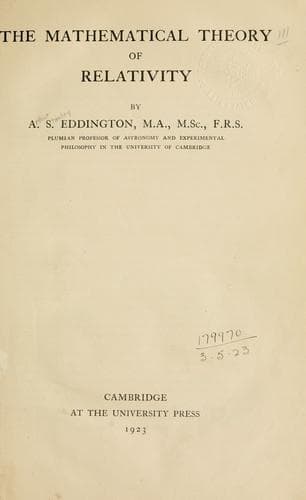
The Mathematical Theory of RelativityEddington, Arthur Stanley, Sir
Science
The Mathematical Theory of Relativity
Eddington, Arthur Stanley, Sir
Relativity (Physics)
This system has some advantages. For example, to obtain the motion of
a light-pulse we set $ds = 0$ in~\Eq{(43.3)}. This gives
\[
\left(\frac{dx}{dt}\right)^{2}
+ \left(\frac{dy}{dt}\right)^{2}
+ \left(\frac{dz}{dt}\right)^{2}
= \frac{(1 - m/2r_{1})^{2}}{(1 + m/2r_{1})^{6}}.
\]
At a distance~$r_{1}$ from the origin the velocity of light is accordingly
\index{Velocity of light!in sun's gravitational field}%
\[
\frac{(1 - m/2r_{1})}{(1 + m/2r_{1})^{3}}
\Tag{(43.4)}
\]
in all directions. For the original coordinates of~\Eq{(38.8)} the velocity of light is
not the same for the radial and transverse directions.
Again in the isotropic system the coordinate length ($\Chg{\surd(x^{2} + y^{2} + z^{2})}{\sqrt{x^{2} + y^{2} + z^{2}}}$) of
a small rod which is rigid ($ds = \text{constant}$) does not alter when the orientation
of the rod is altered. This system of coordinates is naturally arrived at when
we partition space by rigid scales or by light-triangulations in a small region,
e.g.\ in terrestrial measurements. Since the ultimate measurements involved
\PageSep{94}
in any observation are carried out in a terrestrial laboratory we ought, strictly
speaking, always to employ the isotropic system which conforms to assumptions
made in those measurements\footnotemark.\footnotetext
{But the terrestrial laboratory is falling freely towards the sun, and is therefore accelerated
relatively to the coordinates $(x, y, z, t)$.}
But on the earth the quantity~$m/r$ is negligibly
small, so that the two systems coalesce with one another and with Euclidean
coordinates. Non-Euclidean geometry is only required in the theoretical part
of the investigation---the laws of planetary motion and propagation of light
through regions where $m/r$~is not negligible; as soon as the light-waves have
been safely steered into the terrestrial observatory, the need for non-Euclidean
geometry is at an end, and the difference between the isotropic and non-isotropic
systems practically disappears.
In either system the forward velocity of light along any line is equal to
the backward velocity. Consequently the coordinate~$t$ conforms to the convention
(\SecRef{11}) that simultaneity may be determined by means of light-signals.
If we have a clock at~$A$ and send a light-signal at time~$t_{A}$ which reaches~$B$
and is immediately reflected so as to return to~$A$ at time~$t_{A}'$, the time of arrival
at~$B$ will be $\frac{1}{2}(t_{A} + t_{A}')$ just as in the special relativity theory. But the alternative
convention, that simultaneity can be determined by slow transport of
chronometers, breaks down when there is a gravitational field. This is evident
from \SecRef{42}, since the time-rate of a clock will depend on its position in the field.
In any case slow transport of a clock is unrealisable because of the acceleration
which all objects must submit to.
Public-domain text, read in full here on John Shaqi.
Reviews
Reviews
No reviews yet
Be the first to share your thoughts on this work.
Elsewhere in the archive
Join the Discussion
Join the discussion
Sign in to leave a comment or review.
Sign InorCreate an account