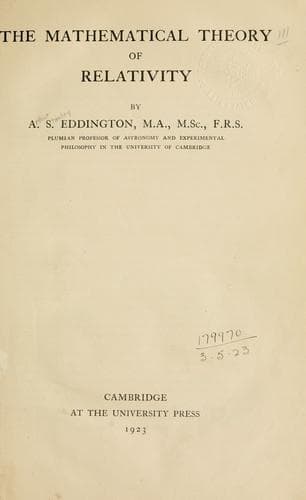
The Mathematical Theory of RelativityEddington, Arthur Stanley, Sir
Science
The Mathematical Theory of Relativity
Eddington, Arthur Stanley, Sir
Relativity (Physics)
If $\Omega_{S}$, $\Omega_{E}$ are the Newtonian potentials of the sun and earth, the leading
terms of (1), (2), (3) will be relatively of order of magnitude
\[
\Omega_{S}^{2},\quad
\Omega_{S}\Omega_{E},\quad
\Omega_{E}.
\]
For the moon $\Omega_{S} = 750\, \Omega_{E}$. We may therefore confine attention to terms of
type~(1). If these prove to be too small to be detected, the others will presumably
be not worth pursuing.
We were able to work out the planetary orbits from Einstein's law independently
of the Newtonian theory; but in the problem of the moon's motion
we must concentrate attention on the difference between Einstein's and Newton's
formulae if we are to avoid repeating the whole labour of the classical
lunar theory. In order to make this comparison we transform \Eq{(39.31)} and
\Eq{(39.32)} so that $t$~is used as the independent variable.
\begin{align*}
\frac{d^{2}}{ds^{2}}
&= \left(\frac{dt}{ds}\right)^{2} \frac{d^{2}}{dt^{2}} + \frac{dt}{ds}\, \frac{d}{dt} \left(\frac{dt}{ds}\right) \frac{d}{dt} \\
&= \left(\frac{dt}{ds}\right)^{2} \left(\frac{d^{2}}{dt^{2}} + \lambda'\, \frac{dr}{dt}\, \frac{d}{dt}\right)
\qquad\text{by \Eq{(39.42)}.}
\end{align*}
Hence the equations \Eq{(39.31)} and \Eq{(39.32)} become
\begin{gather*}
\frac{d^{2}r}{dt^{2}}
+ \tfrac{3}{2}\lambda'\left(\frac{dr}{dt}\right)^{2}
- re^{-\lambda} \left(\frac{d\phi}{dt}\right)^{2}
+ \tfrac{1}{2} e^{2\nu} \nu' = 0,\displaybreak[0] \\
\frac{d^{2}\phi}{dt^{2}}
+ \lambda'\, \frac{dr}{dt}\, \frac{d\phi}{dt}
+ \frac{2}{r}\, \frac{dr}{dt}\, \frac{d\phi}{dt} = 0.
\end{gather*}
Whence
\[
\left.
\begin{aligned}
\frac{d^{2}r}{dt^{2}} - r\left(\frac{d\phi}{dt}\right)^{2} + \frac{m}{r^{2}} &= R\Add{,} \\
r\left(\frac{d^{2}\phi}{dt^{2}} + \frac{2}{r}\, \frac{dr}{dt}\, \frac{d\phi}{dt}\right) &= \Phi\Add{,}
\end{aligned}
\right\}
\Tag{(44.1)}
\]
where
\[
\left.
\begin{aligned}
R &= -\tfrac{3}{2}\lambda' u^{2} - \frac{2m}{r^{2}}\, v^{2} + \frac{2m^{2}}{r^{3}}\Add{,} \\
\Phi &= -\lambda' uv\Add{,}
\end{aligned}
\right\}
\Tag{(44.21)}
\]
and
\[
u = dr/dt,\quad v = r\, d\phi/dt.
\]
\PageSep{97}
Equations \Eq{(44.1)} show that $R$ and~$\Phi$ are the radial and transverse perturbing
forces which Einstein's theory adds to the classical dynamics. To a
sufficient approximation $\lambda' = -2m/r^{2}$, so that
\[
\left.
\begin{aligned}
R &= \frac{m}{r^{2}} (3u^{2} - 2v^{2}) + \frac{2m^{2}}{r^{3}}\Add{,} \\
\Phi &= \frac{m}{r^{2}} · 2uv\Add{.}
\end{aligned}
\right\}
\Tag{(44.22)}
\]
In three-dimensional problems the perturbing forces become
\[
\left.
\begin{aligned}
R &= \frac{m}{r^{2}} (3u^{2} - 2v^{2} - 2w^{2}) + \frac{2m^{2}}{r^{3}}\Add{,} \\
\Phi &= \frac{m}{r^{2}} · 2uv\Add{,} \\
Z &= \frac{m}{r^{2}} · 2uw\Add{.}
\end{aligned}
\right\}
\Tag{(44.23)}
\]
Public-domain text, read in full here on John Shaqi.
Reviews
Reviews
No reviews yet
Be the first to share your thoughts on this work.
Elsewhere in the archive
Join the Discussion
Join the discussion
Sign in to leave a comment or review.
Sign InorCreate an account