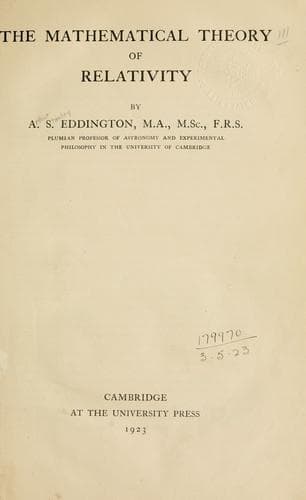
The Mathematical Theory of RelativityEddington, Arthur Stanley, Sir
Science
The Mathematical Theory of Relativity
Eddington, Arthur Stanley, Sir
Relativity (Physics)
The field described by the~$g_{\mu\nu}$ may be (artificially) divided into a \emph{field of
pure inertia} represented by the Galilean values, and a \emph{field of force} represented
by the deviations of the~$g_{\mu\nu}$ from the Galilean values. It is not possible
to superpose the fields of force due to two attracting particles; because the
sum of the two solutions will not satisfy $G_{\mu\nu} = 0$, these equations being non-linear
in the~$g_{\mu\nu}$.
No solution of Einstein's equations has yet been found for a field with two
singularities or particles. The simplest case to be examined would be that of
two equal particles revolving in circular orbits round their centre of mass.
Apparently there should exist a statical solution with two equal singularities;
but the conditions at infinity would differ from those adopted for a single
particle since the axes corresponding to the static solution constitute what is
called a rotating system. The solution has not been found, and it is even
possible that no such statical solution exists. I do not think it has yet been
proved that two bodies can revolve without radiation of energy by gravitational
waves. In discussions of this radiation problem there is a tendency to beg the
question; it is not sufficient to constrain the particles to revolve uniformly,
then calculate the resulting gravitational waves, and verify that the radiation
of gravitational energy across an infinite sphere is zero. That shows that a
statical solution is not obviously inconsistent with itself, but does not demonstrate
its possibility.
The problem of two bodies on Einstein's theory remains an outstanding
challenge to mathematicians---like the problem of three bodies on Newton's
theory.
For practical purposes methods of approximation will suffice. We shall
consider the problem of the field due to the combined attractions of the earth
and sun, and apply it to find the modifications of the moon's orbit required by
the new law of gravitation. The problem has been treated in considerable
detail by de~Sitter\footnotemark.\footnotetext
{\Title{Monthly Notices}, vol.~77, p.~155.}
We shall not here attempt a complete survey of the
\PageSep{96}
problem; but we shall seek out the largest effects to be looked for in refined
observations. There are three sources of fresh perturbations:
(1) The sun's attraction is not accurately given by Newton's law, and the
solar perturbations of the moon's orbit will require corrections.
(2) Cross-terms between the sun's and the earth's fields of force will arise,
since these are not additive.
(3) The earth's field is altered and would \Foreign{inter alia} give rise to a motion
of the lunar perigee analogous to the motion of Mercury's perihelion. It is
easily calculated that this is far too small to be detected.
Public-domain text, read in full here on John Shaqi.
Reviews
Reviews
No reviews yet
Be the first to share your thoughts on this work.
Elsewhere in the archive
Join the Discussion
Join the discussion
Sign in to leave a comment or review.
Sign InorCreate an account