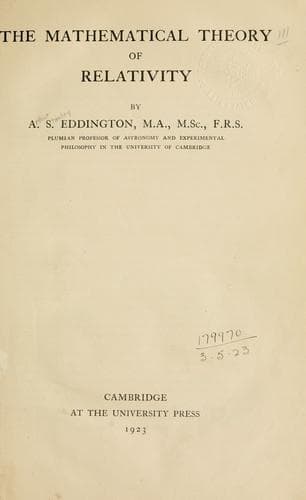
The Mathematical Theory of RelativityEddington, Arthur Stanley, Sir
Science
The Mathematical Theory of Relativity
Eddington, Arthur Stanley, Sir
Relativity (Physics)
When the origin of the $1''.94$ has been traced as in the foregoing investigation,
the anti-relativist who has been arguing that the observed effect is
definitely caused by rotation, must change his position and maintain that it
is definitely due to a gravitational perturbation exerted by the sun on Foucault's
pendulum; the relativist holds to his view that the two causes are not
distinguishable.
\Section{45.}{Solution for a particle in a curved world}
\index{Particle!gravitational field of}%
In later work Einstein has adopted the more general equations~\Eq{(37.4)}
\[
G_{\mu\nu} = \alpha g_{\mu\nu}.
\Tag{(45.1)}
\]
In this case we must modify~\Eq{(38.61)}, etc.\ by inserting $\alpha g_{\mu\nu}$ on the right. We
then obtain
\begin{gather*}
\tfrac{1}{2}\nu'' - \tfrac{1}{4}\lambda'\nu' + \tfrac{1}{4}\nu'^{2} - \lambda'/r = -\alpha e^{\lambda},
\Tag{(45.21)}\displaybreak[0] \\
e^{-\lambda}\bigl(1 + \tfrac{1}{2}r(\nu' - \lambda')\bigr) - 1 = -\alpha r^{2},
\Tag{(45.22)}\displaybreak[0] \\
e^{\nu-\lambda}(-\tfrac{1}{2}\nu'' + \tfrac{1}{4}\lambda'\nu' - \tfrac{1}{4}\nu'^{2} - \nu'/r) = \alpha e^{\nu}.
\Tag{(45.23)}
\end{gather*}
From \Eq{(45.21)} and \Eq{(45.23)}, $\lambda' = -\nu'$, so that we may take $\lambda = -\nu$. An additive
constant would merely amount to an alteration of the unit of time. Equation~\Eq{(45.22)}
then becomes
\[
e^{\nu} (1 + r\nu') = 1 - \alpha r^{2}.
\]
Let $e^{\nu} = \gamma$; then
\[
\gamma + r\gamma' = 1 - \alpha r^{2}
\]
which on integration gives
\[
\gamma = 1 - \frac{2m}{r} - \tfrac{1}{3}\alpha r^{2}.
\Tag{(45.3)}
\]
The only change is the substitution of this new value of~$\gamma$ in~\Eq{(38.8)}.
By recalculating the few steps from \Eq{(39.44)} to \Eq{(39.61)} we obtain the
equation of the orbit
\[
\frac{d^{2}u}{d\phi^{2}} + u = \frac{m}{h^{2}} + 3mu^{2} - \frac{1}{3}\, \frac{\alpha}{h^{2}}\, u^{-3}.
\Tag{(45.4)}
\]
The effect of the new term in~$\alpha$ is to give an additional motion of perihelion
\index{Perihelion!in curved world}%
\[
\frac{\delta\varpi}{\phi} = \frac{1}{2}\, \frac{\alpha h^{6}}{m^{4}}
= \frac{1}{2}\, \frac{\alpha a^{3}}{m}(1 - e^{2})^{3}.
\Tag{(45.5)}
\]
At a place where $\gamma$~vanishes there is an impassable barrier, since any change~$dr$
corresponds to an infinite distance~$i\, ds$ surveyed by measuring-rods. The
two roots of the quadratic~\Eq{(45.3)} are approximately
\[
r = 2m\quad\text{and}\quad
r = \Chg{\surd(3/\alpha)}{\sqrt{3/\alpha}}.
\]
\PageSep{101}
The first root would represent the boundary of the particle---if a genuine particle
\index{Horizon of world}%
could exist---and give it the appearance of impenetrability. The second
barrier is at a very great distance and may be described as the horizon of the
world.
Public-domain text, read in full here on John Shaqi.
Reviews
Reviews
No reviews yet
Be the first to share your thoughts on this work.
Elsewhere in the archive
Join the Discussion
Join the discussion
Sign in to leave a comment or review.
Sign InorCreate an account