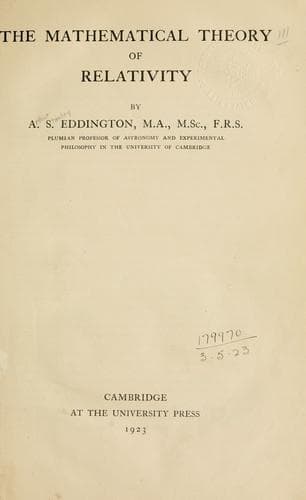
The Mathematical Theory of RelativityEddington, Arthur Stanley, Sir
Science
The Mathematical Theory of Relativity
Eddington, Arthur Stanley, Sir
Relativity (Physics)
It is clear that the latter barrier (or illusion of a barrier) cannot be at a
less distance than the most remote celestial objects observed, say $10^{25}~\text{cm}$.
This makes $\alpha$ less than $10^{-50}~(\text{cm.})^{-2}$. Inserting this value \Typo{(in 45.5)}{in~\Eq{(45.5)}} we find
that the additional motion of perihelion will be well below the limit of observational
detection for all planets in the solar system\footnotemark.\footnotetext
{This could scarcely have been asserted a few years ago, when it was not known that the
stars extended much beyond $1000$ parsecs distance. A horizon distant $700$ parsecs corresponds to
a centennial motion of about~$1''$ in the earth's perihelion, and greater motion for the more
distant planets in direct proportion to their periods.}
If in~\Eq{(45.3)} we set $m = 0$, we abolish the particle at the origin and obtain
the solution for an entirely empty world
\[
ds^{2} = -(1 - \tfrac{1}{3}\alpha r^{2})^{-1}\, dr^{2}
- r^{2} d\theta^{2} - r^{2} \sin^{2}\theta\, d\phi^{2}
+ (1 - \tfrac{1}{3}\alpha r^{2})\, dt^{2}.
\Tag{(45.6)}
\]
This will be further discussed in Chapter~\ChapNum{V}\@.
\Section{46.}{Transition to continuous matter}
\index{Continuous matter, gravitation in}%
\index{Einstein's law of gravitation!in continuous matter}%
In the Newtonian theory of attractions the potential~$\Omega$ in empty space
satisfies the equation
\[
\nabla^{2}\Omega = 0,
\]
of which the elementary solution is $\Omega = m/r$; then by a well-known procedure
we are able to deduce that in continuous matter
\[
\nabla^{2}\Omega = -4\pi\rho.
\Tag{(46.1)}
\]
We can apply the same principle to Einstein's potentials~$g_{\mu\nu}$, which in
empty space satisfy the equations $G_{\mu\nu} = 0$. The elementary solution has been
found, and it remains to deduce the modification of the equations in continuous
matter. The logical aspects of the transition from discrete particles to continuous
density need not be discussed here, since they are the same for both
theories.
When the square of~$m/r$ is neglected, the isotropic solution~\Eq{(43.3)} for a
particle continually at rest becomes\footnote
{This approximation though sufficient for the present purpose is not good enough for a
discussion of the perihelion of Mercury. The term in~$m^{2}/r^{2}$ in the coefficient of~$dt^{2}$ would have to
be retained.}
\[
ds^{2} = -\left(1 + \frac{2m}{r}\right) (dx^{2} + dy^{2} + dz^{2}) + \left(1 - \frac{2m}{r}\right) dt^{2}.
\Tag{(46.15)}
\]
The particle need not be at the origin provided that $r$~is the distance from
the particle to the point considered.
Public-domain text, read in full here on John Shaqi.
Reviews
Reviews
No reviews yet
Be the first to share your thoughts on this work.
Elsewhere in the archive
Join the Discussion
Join the discussion
Sign in to leave a comment or review.
Sign InorCreate an account